
books by Younghee Song
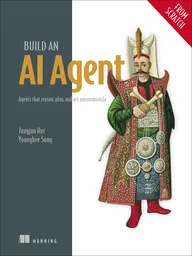
Build an AI Agent (From Scratch)
print book available Jul 28, 2026
ePub + liveBook available Jul 28, 2026
"A practical guide for anyone who wants to move beyond demos and create agentic systems with confidence.”
—Elliot Kim, Coupang Inc.
Build an AI Agent (From Scratch) is a fascinating step-by-step journey through design, development, and deployment of a system of autonomous AI agents. Authors Jungjun Hur and Younghee Song guide you concept by concept as you build a sophisticated research agent in Python, designed to solve complex, multi-step tasks from the rigorous GAIA (General AI Assistants) benchmark. By seeing the construction of the system end to end, you’ll understand how the underlying mechanics are unobstructed by any existing blackbox libraries and frameworks.
This book includes ten meaty chapters and a handy appendix (about how to get an OpenAI API key). The technical explanations throughout the book are made crystal clear by the use of many helpful diagrams. As one reviewer remarked, even for someone building their first agent, “nothing feels like magic or a mystery after the first few chapters!”
Early on, you’ll establish the foundational blueprint for your agent by distinguishing rigid developer-defined workflows from true, LLM-directed agent loops. You’ll learn how to manage stateless APIs, enforce structured outputs using Pydantic, and implement dynamic tool-calling. Crucially, the book centers on “Context Engineering”—the discipline of systematically structuring information to prevent context rot and the “Lost in the Middle” effect. One technical reviewer particularly appreciated that core concepts like agent loops, context engineering, and evaluation are introduced with clear motivation and practical examples rather than as isolated abstractions.
After you build the basic agent, you’ll progressively expand its capabilities by integrating custom web search, local file system exploration, and vector-based RAG to navigate complex data. You’ll also enable the agent to recall past failures and adapt state persistence through hierarchical context optimization and longterm memory. Along the way, you’ll see how to use the Model Context Protocol (MCP) to seamlessly connect your agent to external tools and servers.
Later chapters push into advanced territory. To prevent the agent from hallucinating or looping during complex tasks, you’ll implement explicit planning and procedural reflection. Then, you’ll explore the Code-Act paradigm, empowering the agent with sandboxed cloud environments to securely write scripts, run CLI commands, and compose tools dynamically. Finally, you’ll up-scale your project from a single agent into a collaborative, multi-agent architecture using the A2A protocol, where specialized tasks are routed to isolated sub-agents to maximize token efficiency.
Because highly autonomous agents carry real-world risks, the book culminates in a rigorous observability and evaluation pipeline. You’ll implement an automated LLM-as-a-judge system—powered by Open Telemetry—to trace, grade, and continuously refine the agent’s trajectory and outputs. By building every layer from the ground up, the book ensures that readers are left with a deep, practical understanding of AI mechanics.
