Agent Engineering: Tools, Workflows, and Feedback bundle 
Build agents you can understand, test, and improve! This practical four-chapter sampler shows you how to choose the right level of autonomy, connect agents to useful tools, break complex processes into manageable parts, and catch weak spots with evaluation and feedback. By the end, you’ll have a solid foundation for creating more reliable agent systems and the technical judgment to take on more advanced agent development.
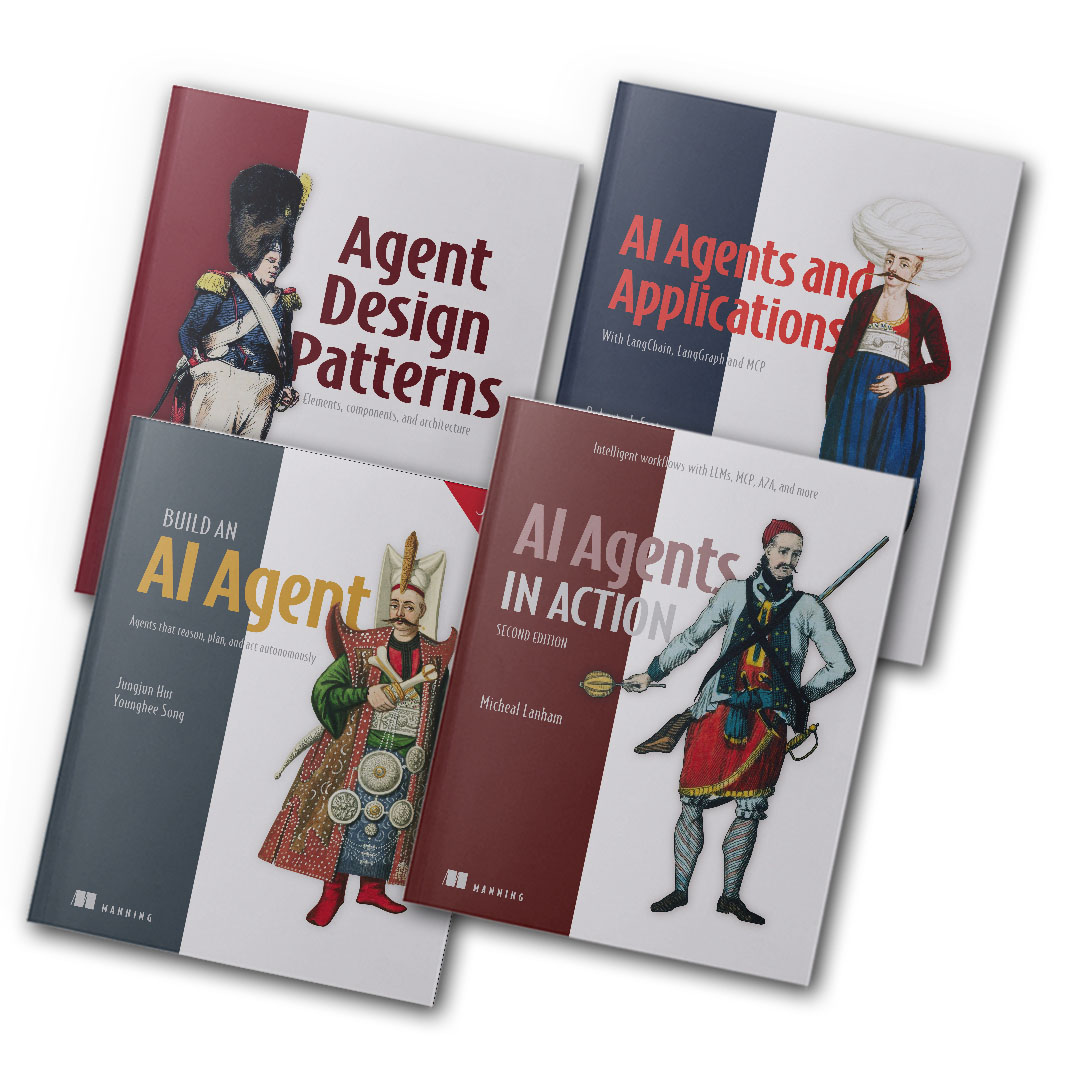


Agent Design Patterns 
 AI agents are showing up everywhere—and most of them are being built by trial and error. Agent Design Patterns distills the experience of a growing community of agent builders into 20+ composable, reusable patterns for building AI agents that are reliable, efficient, controllable, and easy to reason about. In this uniquely valuable book, author and NVIDIA Research scientist Peter Belcak gives you a durable engineering vocabulary and design intuition that outlasts any new model release.
Each pattern included here is production tested and designed to click together as you construct transparent, testable, deployment-ready agentic applications. You’ll appreciate the familiar presentation style, with a simple template of a named problem, a clear solution, benefits, drawbacks, popular variants, and rules for composition with other patterns. Informative diagrams, worked examples, and Belcak’s clear mathematician-turned-engineer voice make even the most subtle patterns easy to internalize.
By the end, you’ll be able to read an underperforming agent, pinpoint the exact quality that is lacking, and reach for the specific pattern that addresses it. You’ll lower per-run costs without redesigning your agent, and even build self-improving agents that auto-tune their own prompts.
AI Agents and Applications
 Along the way you’ll build concrete applications—summarization and Q&A engines, context-aware chatbots with memory, and tool-using AI agents that orchestrate multi-step workflows with branching logic. For the examples, the book uses Python, LangChain, LangGraph, and LangSmith, but you’ll be able to generalize to other frameworks. You’ll understand with clarity and confidence how to keep integrations maintainable, manage context limits and cost/latency tradeoffs, and evaluate, debug, and monitor behavior so your systems work in production.
AI Agents in Action, Second Edition
 "Great contents, broad coverage, fun exercises. This book has it all.”
—Saurabh Sawant, Microsoft
AI Agents in Action, Second Edition is a substantial revision and update of the first edition. It is a practical and comprehensive guide to building AI agents—not just understanding what they are, but designing, implementing, evaluating, and deploying them. Its strength is in the way it combines conceptual clarity with working code examples, so readers build progressively rather than absorb isolated ideas. The examples form a continuous learning path, moving from a minimal agent to more capable, tool-using, multi-agent, and deployable systems. Each step adds a new skill while reinforcing what came before.
The book begins by giving readers a usable mental model for agent design. Its central organizing idea is the five functional layers: persona, actions and tools, reasoning and planning, knowledge and memory, and evaluation and feedback. This framework helps readers understand where an agent’s behavior comes from and how to diagnose weaknesses. Rather than randomly adding prompts, tools, or memory, readers learn to ask which layer needs improvement. This is especially valuable because the model is not tied to one vendor or framework; it remains useful even as APIs and tools continue to change.
From there, the book moves into the practical building blocks of agents: LLMs, prompting, typed outputs, tracing, tool use, and the OpenAI Agents SDK. Typed outputs reduce brittle text parsing. Tracing exposes what the agent is doing. Tool integration gives agents the ability to act rather than merely respond. The cumulative benefit is that readers learn to build agents that are more predictable, inspectable, and maintainable.
A highlight is the treatment of Model Context Protocol. Readers liked the book’s “USB-C” analogy, because it explains MCP as a standard connector between agents and external capabilities. The book shows how MCP can flatten “a mess of bespoke integrations” into cleaner, swappable components, helping developers build agents that are modular instead of tangled.
The book also covers multi-agent architectures, reasoning patterns, planning strategies, RAG, memory, evaluation, feedback, observability, and deployment. Each topic is tied to a practical benefit: multi-agent patterns help divide complex work; reasoning and planning help agents handle multi-step tasks; RAG and memory let agents use external and retained knowledge; evaluation and feedback help make them safer and more reliable.
Physically, this is a substantial but focused book covering 392 pages across 11 chapters. Its tables and figures are a valuable part of the learning experience. While building, readers will want to return to the easy-to-use tables summarizing complex trade-offs.
AI Agents in Action shows developers how to build agents they can ship, trust, and maintain.
Build an AI Agent (From Scratch)
 "A practical guide for anyone who wants to move beyond demos and create agentic systems with confidence.”
—Elliot Kim, Coupang Inc.
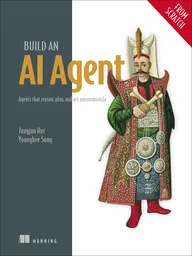
Build an AI Agent (From Scratch) is a fascinating step-by-step journey through design, development, and deployment of a system of autonomous AI agents. Authors Jungjun Hur and Younghee Song guide you concept by concept as you build a sophisticated research agent in Python, designed to solve complex, multi-step tasks from the rigorous GAIA (General AI Assistants) benchmark. By seeing the construction of the system end to end, you’ll understand how the underlying mechanics are unobstructed by any existing blackbox libraries and frameworks.
This book includes ten meaty chapters and a handy appendix (about how to get an OpenAI API key). The technical explanations throughout the book are made crystal clear by the use of many helpful diagrams. As one reviewer remarked, even for someone building their first agent, “nothing feels like magic or a mystery after the first few chapters!”
Early on, you’ll establish the foundational blueprint for your agent by distinguishing rigid developer-defined workflows from true, LLM-directed agent loops. You’ll learn how to manage stateless APIs, enforce structured outputs using Pydantic, and implement dynamic tool-calling. Crucially, the book centers on “Context Engineering”—the discipline of systematically structuring information to prevent context rot and the “Lost in the Middle” effect. One technical reviewer particularly appreciated that core concepts like agent loops, context engineering, and evaluation are introduced with clear motivation and practical examples rather than as isolated abstractions.
After you build the basic agent, you’ll progressively expand its capabilities by integrating custom web search, local file system exploration, and vector-based RAG to navigate complex data. You’ll also enable the agent to recall past failures and adapt state persistence through hierarchical context optimization and longterm memory. Along the way, you’ll see how to use the Model Context Protocol (MCP) to seamlessly connect your agent to external tools and servers.
Later chapters push into advanced territory. To prevent the agent from hallucinating or looping during complex tasks, you’ll implement explicit planning and procedural reflection. Then, you’ll explore the Code-Act paradigm, empowering the agent with sandboxed cloud environments to securely write scripts, run CLI commands, and compose tools dynamically. Finally, you’ll up-scale your project from a single agent into a collaborative, multi-agent architecture using the A2A protocol, where specialized tasks are routed to isolated sub-agents to maximize token efficiency.
Because highly autonomous agents carry real-world risks, the book culminates in a rigorous observability and evaluation pipeline. You’ll implement an automated LLM-as-a-judge system—powered by Open Telemetry—to trace, grade, and continuously refine the agent’s trajectory and outputs. By building every layer from the ground up, the book ensures that readers are left with a deep, practical understanding of AI mechanics.
Some bundled books and liveVideos are part of the Manning Early Access Program. You'll get all the available content now, new content as it's created, and the final product when it's ready.
