1 The frontend interview
This chapter sets expectations for the modern frontend interview and what it now demands from candidates. Beyond listing credentials, employers look for fluency in core web technologies (HTML, CSS, JavaScript, and TypeScript), hands-on expertise with leading frameworks—especially React—and an ability to build responsive, accessible, high-quality interfaces. The bar has risen to include system design thinking, performance and scalability across devices and networks, strong collaboration with cross‑functional teams, and adaptability to evolving workflows, including the effective use of AI tools. Through the story of Jane, an experienced engineer who fell short despite solid coding, the chapter underscores that communication, architectural reasoning, and clear articulation of trade-offs are as critical as writing working code.
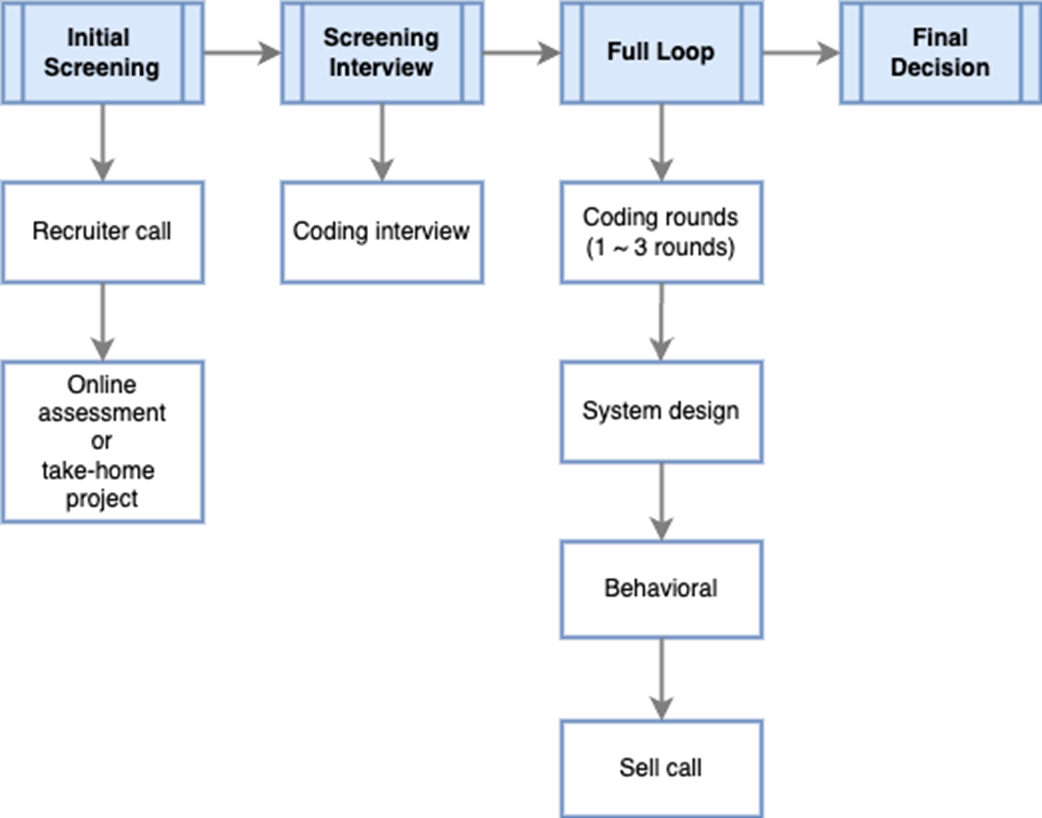
The chapter demystifies the typical process into four stages: an initial screening, a technical screening, a comprehensive interview loop, and a final decision. It highlights a clear shift from algorithm-heavy challenges toward practical, project-based exercises—often pair programmed—that evaluate React fundamentals, UI/UX considerations, accessibility, testing, edge cases, and error handling. System design rounds probe a candidate’s ability to reason about APIs, caching, data flows, rendering performance, and scalable component architecture, while behavioral interviews assess teamwork, learning agility, and cultural fit. To navigate these conversations, the “funneling” technique moves from broad answers to deeper, targeted explanations; candidates are coached to master fundamentals, listen actively, clarify scope, structure responses, manage time, and adapt depth based on interviewer cues.
Preparation recommendations focus on strengthening core foundations and developing deep React proficiency, given its market dominance, ecosystem, and transferability of skills. Non‑React developers are encouraged to leverage prior framework experience, learn JSX and hooks, practice through small projects, and become comfortable with common React-adjacent tooling. The chapter also covers interview environments and platforms frequently used for coding tests and emphasizes adaptability across setups, including TypeScript-enabled projects. Finally, it addresses the growing importance of AI in daily workflows and interviews—how it accelerates development, where it helps or harms, and how to speak credibly about its use—setting the stage for hands-on exercises and system design preparation that build confidence for the full interview loop.
Overview of a typical frontend interview process.
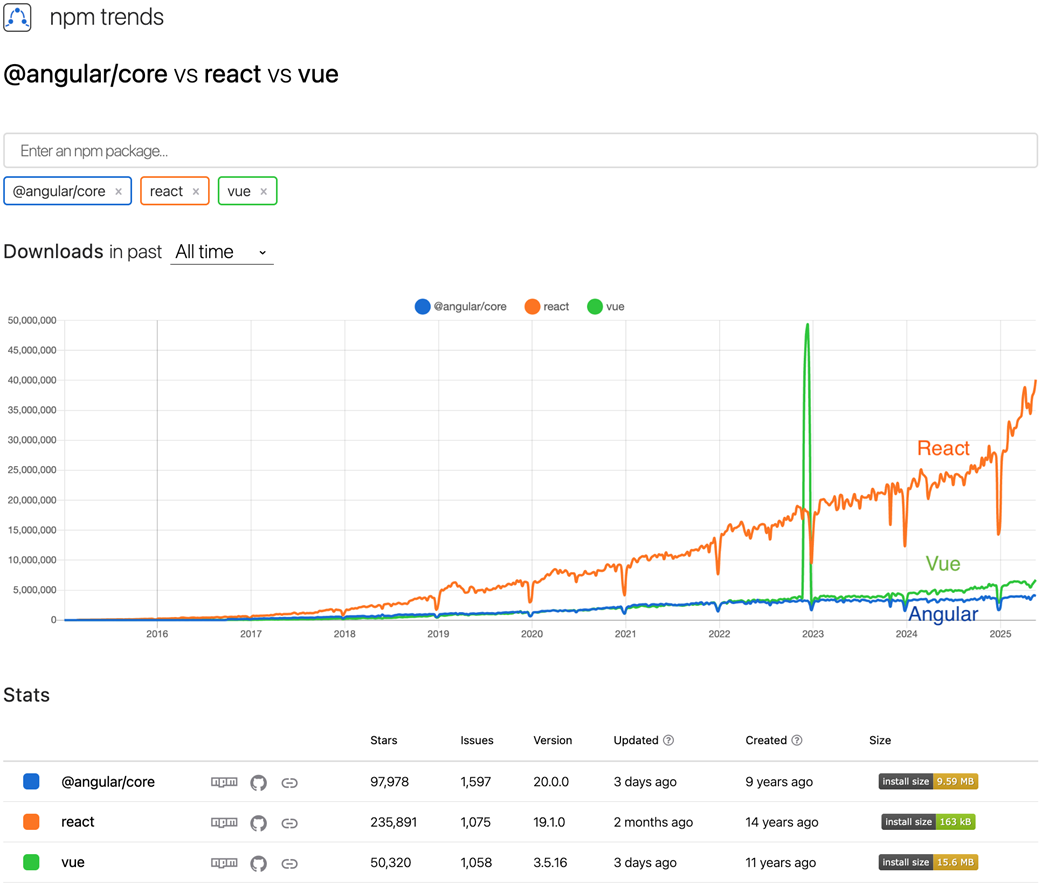
Weekly npm downloads of React, Vue, and Angular as of May 18, 2025: React – 40.1 million, Vue – 6.7 million, and Angular – 4.0 million.
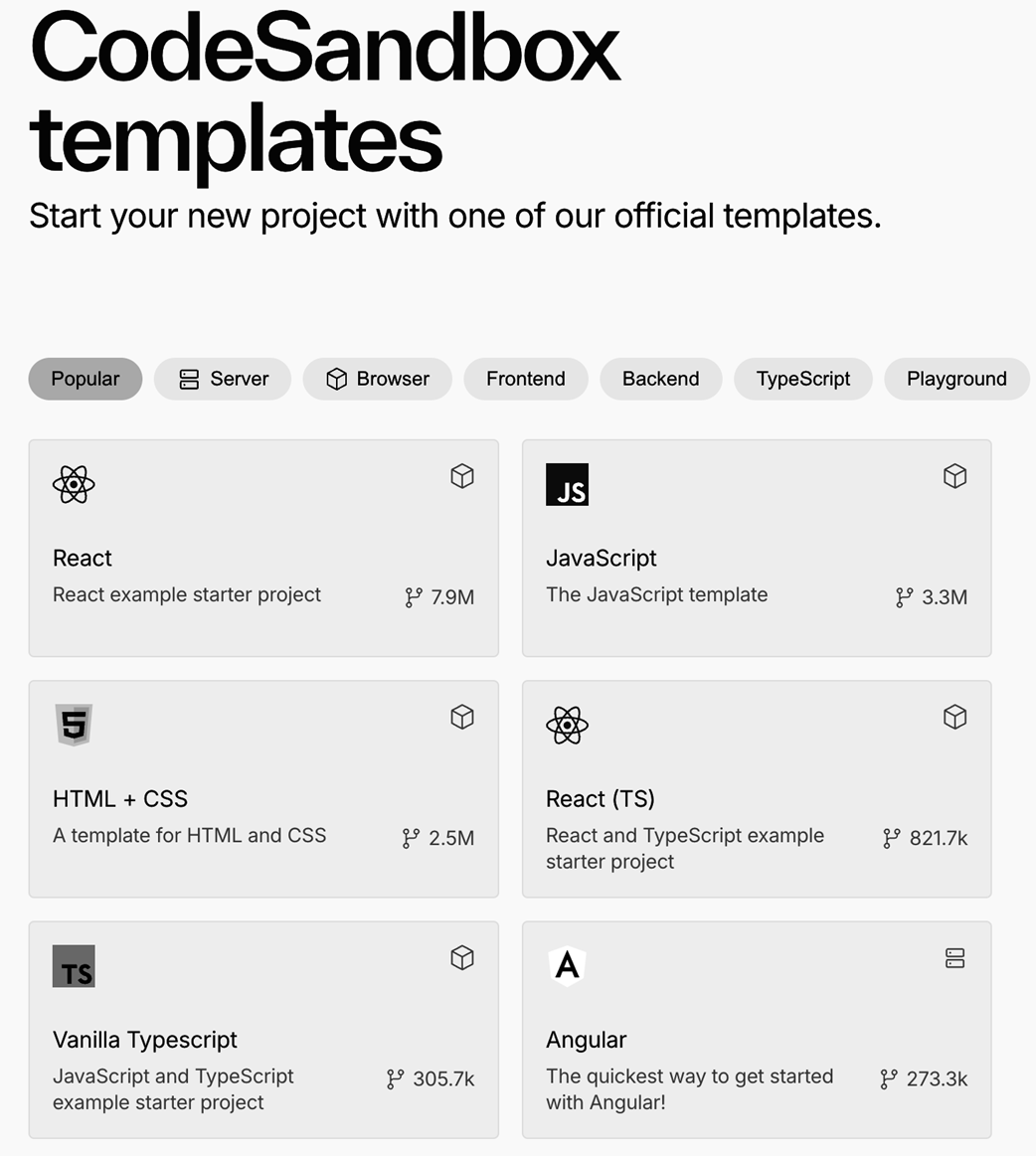
CodeSandbox templates for web development
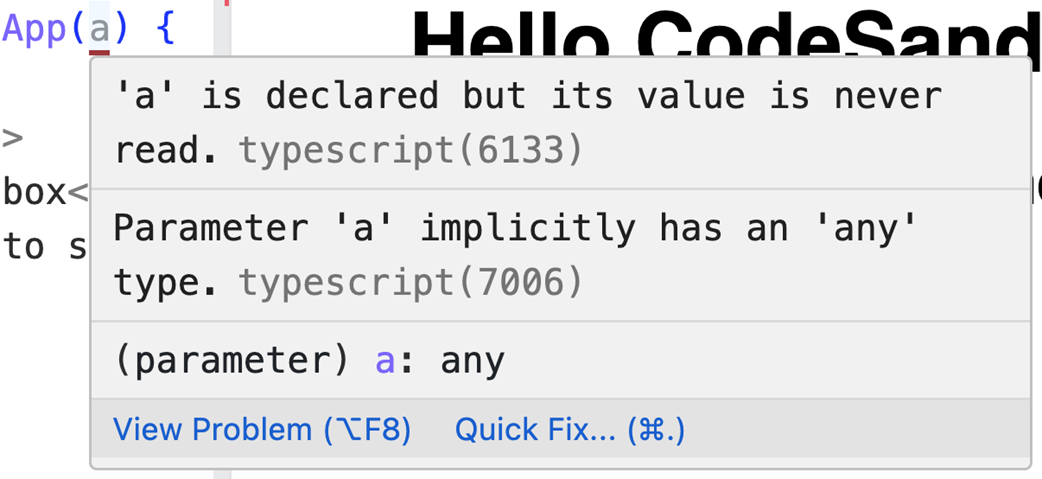
Create React App with TypeScript, displaying a warning for undefined type.
Summary
- A typical frontend interview process includes four stages: initial screening, screening interview, full loop, and final decision.
- The funneling approach begins with broad, open-ended questions and narrows to more specific topics.
- Frontend interviews typically cover core web technologies (HTML, CSS, JavaScript/TypeScript), expert knowledge of frameworks like React, system design, behavioral assessments, and increasingly, AI-related topics.
- React, Angular, and Vue are the leading web frameworks for building user interfaces, with React being the most popular and widely adopted.
- Transitioning from Angular or Vue to React can be straightforward with effective strategies and a focus on shared concepts, such as component architecture and state management.
- Platforms like CodeSandbox are frequently used as coding test environments, offering up-to-date React tooling.
FAQ
What are the main stages of a modern frontend interview?
- Initial screening: Recruiter call to verify background, work authorization/visa, compensation range; occasional basic quizzes.
- Screening interview: Short coding assessment (JS/React UI or functions) on a shared platform; brief product/company fit questions.
- Full loop: Multiple rounds with project-based coding (often pair programming), system design, and a behavioral interview; sometimes an executive “sell” call.
- Final decision: Hiring team reviews feedback and decides on an offer.
Why do frontend interviews include system design now?
Modern teams use domain-based ownership, micro-frontends, and CI/CD, so frontend engineers co-own the SDLC. Candidates are expected to reason about scalability, rendering performance, API contracts, caching, data workflows, and integration with backend/DevOps—demonstrating they can design and ship resilient, cross-domain web apps.
How are frontend coding assessments changing?
- Less LeetCode-heavy; more project-style tasks that mirror real work.
- Commonly React-focused exercises (for example, a star rating component).
- Interviewers assess hooks/state, component design, UX/accessibility, testing, edge cases, and error handling.
- Often done in pair-programming to observe collaboration and thinking.
What is the funneling approach and how should I answer?
- Starts broad, then narrows with follow-ups and probing questions to test depth.
- Answer strategy: Begin with a concise overview, ask if more depth is desired, then drill into specifics.
- Use structured frameworks (e.g., RADIO or STAR), listen actively, clarify scope, and manage time.
Which fundamentals should I master before interviewing?
- Core web: HTML, CSS, JavaScript, and TypeScript.
- React: Components, JSX, state/props, hooks, data flow, performance (virtual DOM), and ecosystem (routing, state mgmt, SSR/SSG).
- Awareness of Angular/Vue helps, but hands-on React skill is most in demand.
What do interviewers evaluate in a React UI task?
- Technical: State management, hooks, component architecture, and rendering performance.
- Product/UX: Interaction handling, responsiveness, and accessibility (ARIA).
- Quality: Code organization, tests, edge cases, and graceful error paths.
- Extensions they may request: Toggle/clear rating, half-stars, animations, full ARIA support.
How should I discuss AI tools in a frontend interview?
- Benefits: Faster scaffolding, refactors, tests, debugging, and code search.
- Examples: Copilot autocompletion, agentic IDEs (e.g., Cursor) for multi-file changes, assistants for design/accessibility checks.
- Risks: Hallucinations, security/licensing concerns, overreliance—explain your review process and judgment.
- Preparation: Practice with AI so you can cite concrete, balanced examples.
Which coding platforms are common, and how do I prepare?
- Common tools: CodeSandbox, StackBlitz, CoderPad, HackerRank, CodeSignal, GitHub Codespaces.
- Preparation: Practice on the stated platform, learn how to run/share projects, and get comfortable collaborating in real time.
- Expectations: Real-world-like setups with up-to-date React and tooling.
How do I handle interview environment quirks (TypeScript, CRA, Vite, etc.)?
- CRA is deprecated; many interviews use Vite or similar modern setups.
- It’s usually fine to write JavaScript in a TS template—explain any “implicit any” lint warnings or add quick types.
- If the environment is limited (e.g., no preview), communicate constraints, write clear code, and describe how you’d verify and iterate.
What are the key lessons from Jane’s interview story?
- Don’t just code—narrate your reasoning, trade-offs, and test/edge-case thinking.
- Be ready for backend-adjacent system design topics (APIs, caching, performance).
- Come prepared with examples of how you use AI tools responsibly.
- Strong fundamentals plus adaptability and communication are decisive.

 Acing the Frontend Interview ebook for free