This chapter introduces AI Engineering as the disciplined practice of building production systems with modern AI, contrasting it with one-off prompt crafting. It explains the demo-to-production gap: what works in a single chat often fails at scale without architecture to manage quality, latency, cost, and risk. The blueprint centers on five integrated layers—prompt routing, retrieval-augmented generation (RAG), structured prompts, autonomous agents, and operational infrastructure—showing when simple prompting suffices and when engineering is required for integration, consistency, security, and economic viability.
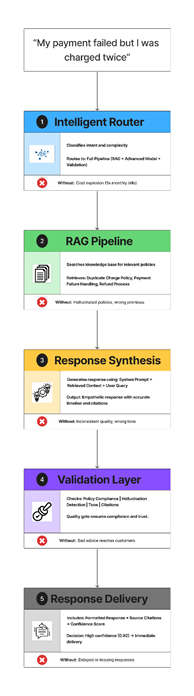
Real-world outcomes illustrate the stakes. An airline’s chatbot fiasco stemmed from missing guardrails and monitoring, while Klarna’s assistant succeeded by combining routing to the right model, grounding answers in company data, layered validation, and continuous evaluation. The chapter walks a single customer query through the full pipeline: classification and routing to balance cost and capability; semantic retrieval to ground responses; structured prompting to control tone and format; automated checks for policy compliance and hallucinations; and confidence-based escalation to humans. The message is clear: reliability emerges from modular layers that isolate failures and make systems observable and maintainable.
Beyond principles, the chapter provides a pragmatic diagnostic lens that maps symptoms to architectural fixes—runaway costs to routing, hallucinations to missing RAG, inconsistent outputs to weak prompts, policy violations to absent validation, multi-step brittleness to workflow or agent gaps, and vulnerabilities to missing security controls. Case studies in support, legal analysis, and operations show measurable gains in accuracy, speed, and cost. Finally, the roadmap frames how foundational prompt skills evolve into production AI systems, extending software engineering fundamentals with AI-specific patterns to deliver trustworthy, scalable applications.
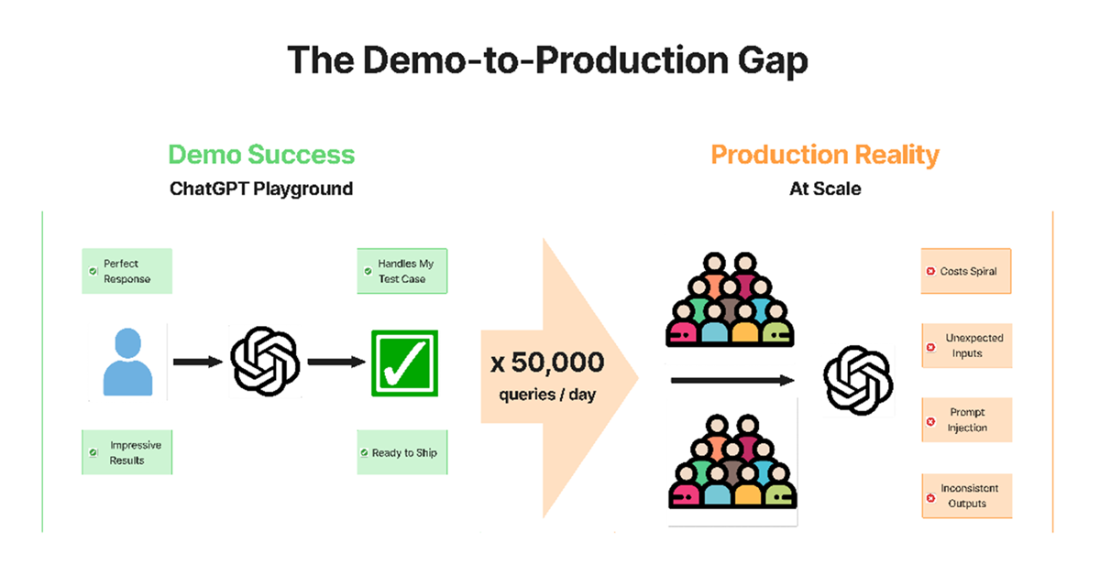
The Demo-to-Production Gap
Production AI System Architecture
Summary
Ad-hoc prompting collapses at production scale - Air Canada's chatbot hallucinated policies costing $3.2M, while Klarna's engineered system handled 2.3M conversations monthly through systematic architecture, not better prompts.
The demo-to-production gap emerges at scale - single-case success fails when serving thousands daily, exposing edge cases, context limits, cost explosions, and security vulnerabilities invisible in testing.
Even simple tasks hide engineering complexity - product descriptions need parameterized templates, structured schemas, validation frameworks, and performance monitoring to sustain quality beyond initial demos.
Production reliability comes from layered defenses - routing cuts costs 60-80%, RAG eliminates hallucinations through verified grounding, validation catches errors like the $3,650 in unauthorized gift cards promised to 73 customers.
This blueprint transforms isolated techniques into production systems - you'll build architectures that prevent Air Canada's disasters while achieving Klarna's scale, handling thousands of daily interactions with measurable reliability.
FAQ
What is AI Engineering and how is it different from Prompt Engineering?AI Engineering is software engineering that incorporates modern AI (LLMs, embeddings, vector databases) to solve problems with unstructured data. It extends software fundamentals—architecture, testing, error handling, monitoring—with AI-specific patterns like retrieval, validation, routing, and agents. Prompt Engineering focuses on communicating effectively with models; AI Engineering builds production systems around those prompts for reliability, scalability, cost control, and governance.When should I move beyond simple prompting to AI Engineering?Adopt AI Engineering when any of the following apply: outputs must feed databases or trigger APIs; quality must be consistent across thousands of users; failures have consequences (customer-facing, financial, legal, medical); costs matter at scale; or you face security threats like prompt injection or data exfiltration. Simple prompting is fine for personal productivity and low-stakes drafts that humans review.What are the five architectural layers in the blueprint?The blueprint comprises: 1) Prompt Routing—send each request to the right model/pipeline by topic and complexity; 2) RAG (Retrieval Augmented Generation)—ground responses in authoritative documents via semantic search; 3) Prompt Engineering—structured instructions, formats, and templates for consistent outputs; 4) Autonomous Agents—multi-step, tool-using workflows for complex tasks; 5) Operational Infrastructure—evaluation, monitoring, cost optimization, security, and lifecycle management.How does prompt routing reduce cost without hurting quality?Routing classifies requests (e.g., simple vs. complex) and directs them to the most appropriate, cost-effective resource, reserving advanced models for truly hard cases. In practice this typically cuts costs by 60–80%. The chapter’s example shows monthly spend around $2,580 with routing versus $15,000 if every query hits premium models—while maintaining quality by escalating complex queries when needed.What is RAG and how does it reduce hallucinations?RAG (Retrieval Augmented Generation) searches a knowledge base for relevant, up-to-date documents (via a vector database for semantic similarity) and injects them into the prompt. Grounding generation in authoritative sources—with citations—dramatically reduces hallucinations and prevents invented policies or promises.What validation and quality controls should sit between the model and the user?Use a validation layer that includes: policy compliance checks; hallucination detection (e.g., model-as-a-judge verifying claims appear in sources); tone and style checks; citation validation; and confidence scoring with thresholds that trigger human review. These guardrails catch costly errors before they reach customers.How does a single customer query flow through the production pipeline?A typical flow: the router classifies the query and selects the pipeline; RAG retrieves relevant policies and procedures; structured prompts synthesize a grounded, on-brand response with citations; the validation layer checks policy alignment, groundedness, tone, and citations; finally, the system delivers a response with a confidence score, auto-escalating to human review if below threshold.How do I diagnose common failures in production AI systems?Match symptoms to layers: high API costs → routing inefficiency; hallucinations → missing/weak RAG; inconsistent quality → prompt engineering gaps; policy violations/operational risk → insufficient validation; failure on multi-step tasks → inadequate chaining/agent design; security incidents from malicious inputs → missing defensive patterns and privilege separation.How do I scale a simple content-generation prompt into a production workflow?Move from an ad-hoc prompt to a parameterized template with explicit instructions and output formats; enforce structured outputs (e.g., JSON) for database insertion; add validation to catch regressions; monitor costs and performance; apply routing to choose models per item; and architect around context limits with retrieval and batching. This enables thousands of items/day within budget and consistent quality.What real results can AI Engineering deliver compared to ad-hoc prompting?Case studies show transformative outcomes: customer support improved accuracy and response times with routing, RAG, and validation; legal document analysis dropped from ~40 hours to ~2 hours with ~95% extraction accuracy under human review; manufacturing intake achieved near real-time processing with ~98% accuracy via schemas, validation, retries, and API integration. Systematic architecture—not ad-hoc prompts—drives reliability, scale, and cost efficiency.
pro $24.99 per month
access to all Manning books, MEAPs, liveVideos, liveProjects, and audiobooks!

 AI Engineering in Practice ebook for free