Overview

1 The world of the Apache Iceberg Lakehouse

Modern data architectures have evolved through cycles of trade-offs among cost, performance, flexibility, and governance—from OLTP systems to enterprise and cloud data warehouses, then to Hadoop-era data lakes. Warehouses delivered fast analytics but were costly and rigid, while lakes offered inexpensive, scalable storage but suffered from weak consistency, slow queries, and governance gaps that often led to “data swamps.” The data lakehouse emerged to unite the strengths of both: warehouse-grade reliability and performance on top of open, low-cost data lake storage, enabling a single source of truth accessible by many tools without heavy data movement or vendor lock-in.

Apache Iceberg is the key enabler of this model. As an open table format, it wraps data files with a rich, multi-layer metadata system that powers fast query planning and safe concurrent writes across engines. Iceberg brings ACID transactions, schema and partition evolution, time travel, and hidden partitioning to the lake—eliminating brittle rewrites, reducing accidental full scans, and making historical analysis and recovery straightforward. Its vendor-agnostic standard and broad ecosystem support allow teams to analyze the same canonical datasets with their preferred tools while minimizing duplication, ETL overhead, and compute costs.

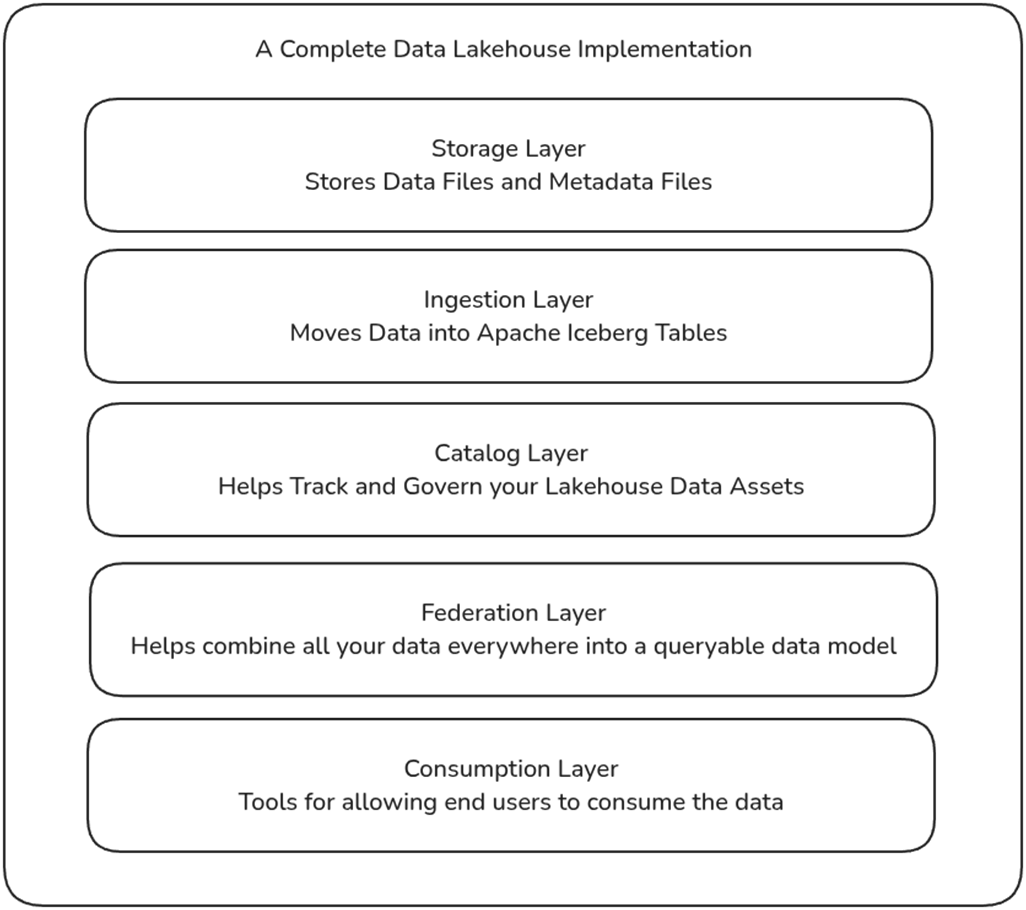
An Iceberg lakehouse is built from modular components that scale independently: a storage layer (object stores or distributed filesystems) holding data and metadata; an ingestion layer supporting batch and streaming writes; a catalog layer governing table discovery, versions, and access; a federation layer for modeling, semantic consistency, and query acceleration across sources; and a consumption layer spanning BI, AI/ML, and operational apps. This architecture delivers consistent analytics across business units, high performance directly on lake storage, and meaningful cost savings by avoiding redundant copies. Organizations adopt Iceberg when they need open, interoperable, AI-ready analytics at scale—with strong governance, shared truth, and the freedom to choose best-of-breed tools over time.

The evolution of data platforms from on-prem warehouses to data lakehouses.

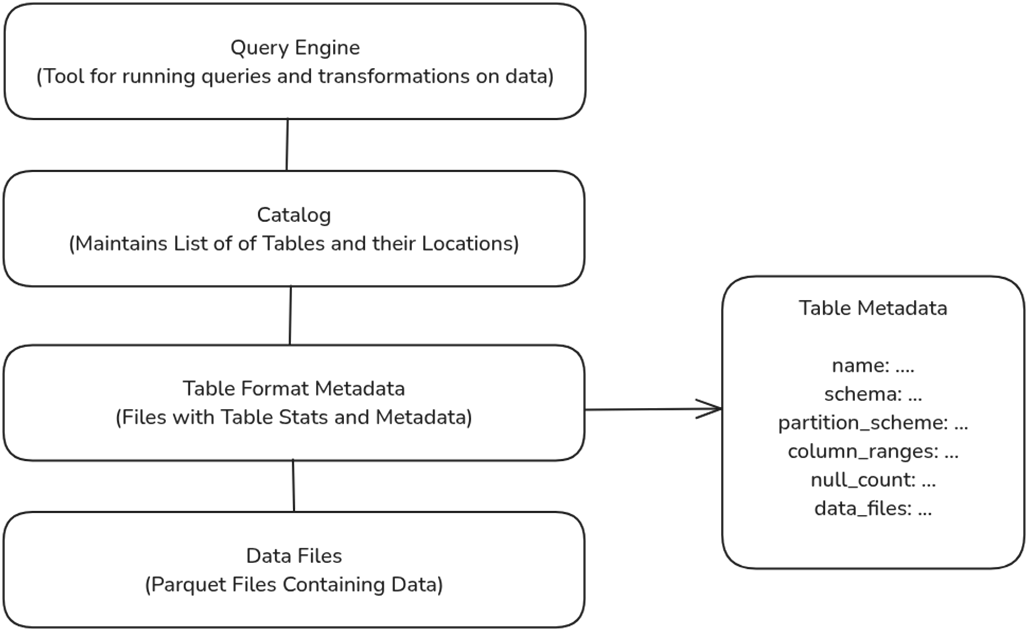
The role of the table format in data lakehouses.
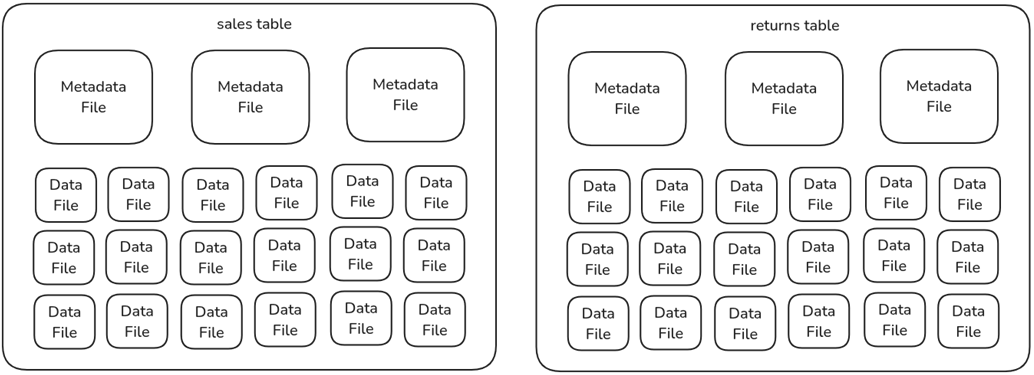
The anatomy of a lakehouse table, metadata files, and data files.
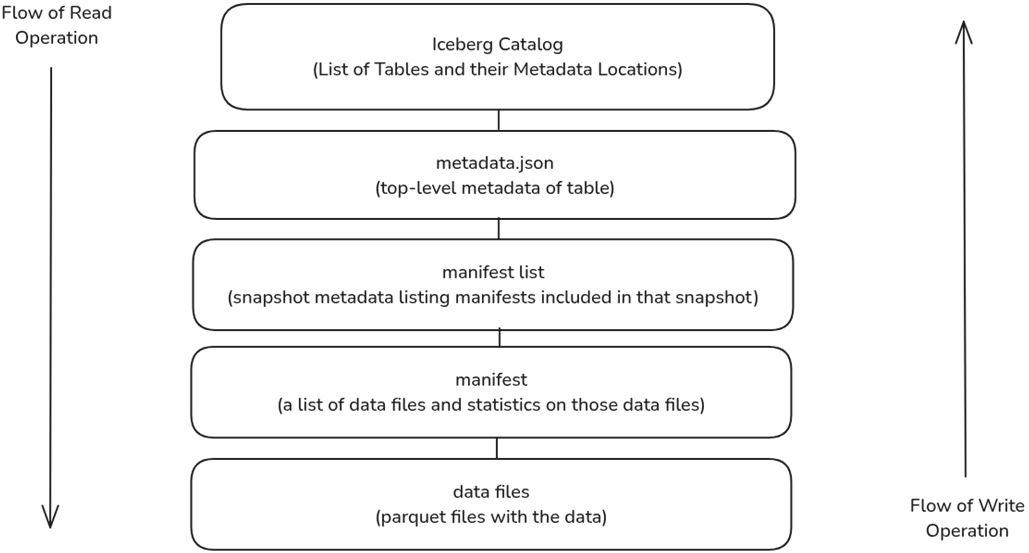
The structure and flow of an Apache Iceberg table read and write operation.
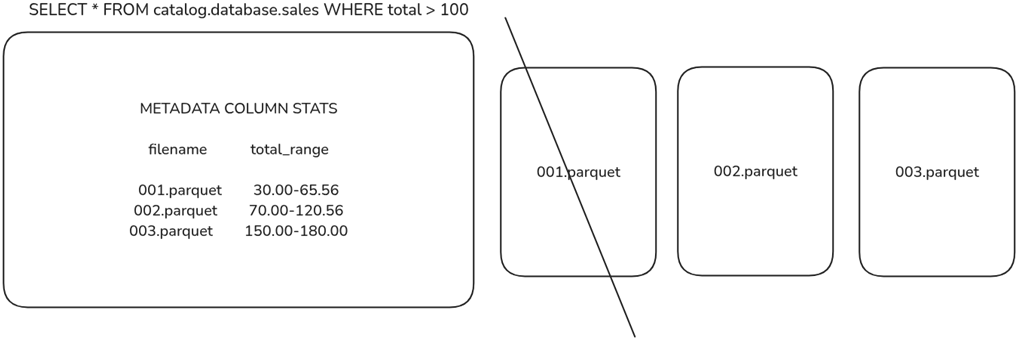
Engines use metadata statistics to eliminate data files from being scanned for faster queries.
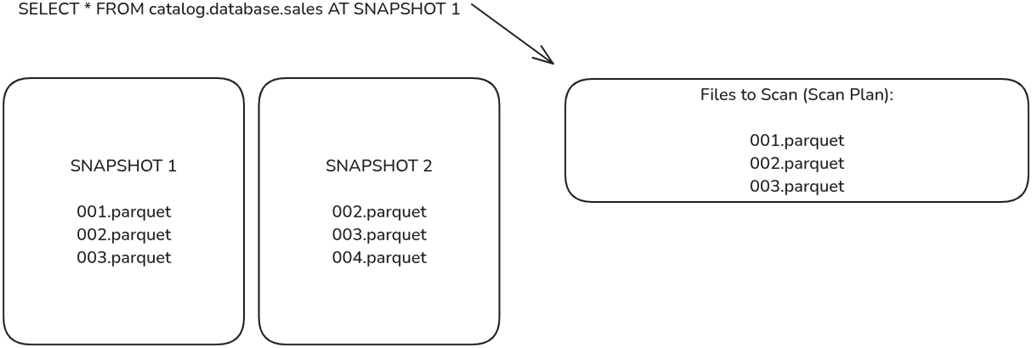
Engines can scan older snapshots, which will provide a different list of files to scan, enabling scanning older versions of the data.
The components of a complete data lakehouse implementation
Summary

  • Data lakehouse architecture combines the scalability and cost-efficiency of data lakes with the performance, ease of use, and structure of data warehouses, solving key challenges in governance, query performance, and cost management.
  • Apache Iceberg is a modern table format that enables high-performance analytics, schema evolution, ACID transactions, and metadata scalability. It transforms data lakes into structured, mutable, governed storage platforms.
  • Iceberg eliminates significant pain points of OLTP databases, enterprise data warehouses, and Hadoop-based data lakes, including high costs, rigid schemas, slow queries, and inconsistent data governance.
  • With features like time travel, partition evolution, and hidden partitioning, Iceberg reduces storage costs, simplifies ETL, and optimizes compute resources, making data analytics more efficient.
  • Iceberg integrates with query engines (Trino, Dremio, Snowflake), processing frameworks (Spark, Flink), and open lakehouse catalogs (Nessie, Polaris, Gravitino), enabling modular, vendor-agnostic architectures.
  • The Apache Iceberg Lakehouse has five key components: storage, ingestion, catalog, federation, and consumption.

FAQ

What is a data lakehouse?A data lakehouse is an architecture that combines the low-cost, flexible storage of data lakes with the performance, governance, and ease of use of data warehouses. It relies on open table formats (such as Apache Iceberg) so multiple engines can access the same data without duplication or vendor lock-in.
Why did the lakehouse pattern emerge?Traditional OLTP systems struggled with analytics, enterprise data warehouses were costly and rigid, and Hadoop-era data lakes lacked consistency, governance, and speed. Cloud warehouses improved elasticity but still incurred premium costs, data movement, and lock-in. The lakehouse arose to resolve these trade-offs with an open, scalable, and performant approach.
What is Apache Iceberg and what problem does it solve?Apache Iceberg is an open, vendor-agnostic table format that makes collections of files (typically Parquet) behave like managed database tables. It adds ACID transactions, schema evolution, partitions and statistics for pruning, and snapshots, enabling reliable, fast analytics directly on the data lake across many engines.
How does Iceberg’s metadata model work?Iceberg uses a layered metadata design to speed up planning and scans: table metadata (metadata.json) tracks schema, partitions, and snapshots; manifest lists describe each snapshot; and manifests list individual data files with statistics. Engines use this to prune unnecessary files before scanning.
What are Iceberg’s key features?Core capabilities include ACID transactions, schema evolution, time travel (snapshot-based queries), partition evolution, and hidden partitioning. Together they deliver reliable multi-writer concurrency, adaptable data models, reproducible historical queries, and efficient scans without manual tuning.
What is hidden partitioning and partition evolution?Hidden partitioning automatically records and applies partition transforms in metadata, so users don’t need to include partition columns in queries—reducing accidental full-table scans. Partition evolution lets you change partition strategies over time without rewriting existing data.
How does Iceberg improve performance and cost?Iceberg’s metadata-driven pruning cuts scanned data, lowering compute. A single canonical copy in the lake reduces duplication across warehouses and marts. It supports batch and streaming into the same tables, minimizing data movement and ETL overhead while enabling fast, lake-native analytics.
How does Iceberg compare to Delta Lake, Hudi, and Paimon?All offer ACID, schema evolution, and time travel, but Iceberg stands out with partition evolution and hidden partitioning, broad multi-engine support (Spark, Flink, Trino, Dremio, Snowflake, BigQuery, etc.), and community-led Apache governance—reducing vendor dependence and easing ecosystem integration.
What are the main components of an Iceberg lakehouse?An Iceberg lakehouse typically includes: storage (object stores for data and metadata), ingestion (batch/streaming into Iceberg), catalog (tracks tables and metadata locations), federation (semantic modeling and acceleration across sources), and consumption (BI, AI/ML, apps).
What does the catalog do, and what options exist?The catalog is the entry point that discovers tables and their metadata, enabling atomic updates, cross-engine interoperability, and centralized governance. Options include Hive Metastore (legacy), AWS Glue, Project Nessie, Apache Polaris, Apache Gravitino, Lakekeeper, and the Iceberg REST Catalog standard.

pro $24.99 per month

  • access to all Manning books, MEAPs, liveVideos, liveProjects, and audiobooks!
  • choose one free eBook per month to keep
  • exclusive 50% discount on all purchases
  • renews monthly, pause or cancel renewal anytime

lite $19.99 per month

  • access to all Manning books, including MEAPs!

team

5, 10 or 20 seats+ for your team - learn more


choose your plan

team

monthly
annual
$49.99
$499.99
only $41.67 per month
  • five seats for your team
  • access to all Manning books, MEAPs, liveVideos, liveProjects, and audiobooks!
  • choose another free product every time you renew
  • choose twelve free products per year
  • exclusive 50% discount on all purchases
  • renews monthly, pause or cancel renewal anytime
  • renews annually, pause or cancel renewal anytime
  • Architecting an Apache Iceberg Lakehouse ebook for free

choose your plan

team

monthly
annual
$49.99
$499.99
only $41.67 per month
  • five seats for your team
  • access to all Manning books, MEAPs, liveVideos, liveProjects, and audiobooks!
  • choose another free product every time you renew
  • choose twelve free products per year
  • exclusive 50% discount on all purchases
  • renews monthly, pause or cancel renewal anytime
  • renews annually, pause or cancel renewal anytime
  • Architecting an Apache Iceberg Lakehouse ebook for free