1 Why authorization matters: Securing access in a digital world
Authorization is presented as a foundational concern in modern digital systems because access decisions shape both security and the features applications can offer. A major breach at Target illustrates how weak boundaries and poor response can let a limited vendor compromise expand into a catastrophic incident, showing that it is not enough to know who is logging in; systems must also control what they can do. The chapter argues that identity systems exist to manage relationships, with authentication identifying the requester, accounts storing information about them, and authorization deciding whether a request should be allowed.
The text contrasts traditional access control methods such as ACLs, groups, and roles with dynamic, policy-based authorization. Static approaches struggle as systems grow because they become hard to scale, inflexible, difficult to maintain, inefficient for distributed environments, hard to audit, and prone to security drift. By externalizing access logic into policies evaluated at runtime, organizations can make decisions based on context, relationships, and changing conditions, improving consistency, transparency, and alignment with business intent.
The chapter also shows that authorization is not just a security mechanism but a business capability. In cloud services, SaaS platforms, zero-trust models, IoT systems, regulatory compliance, and AI-driven applications, access control directly affects usability, trust, and growth. Dynamic authorization supports these needs through policy as code and policy as data, which together provide flexibility, auditability, and scalability. The overarching message is that authorization should be treated as architecture: a strategic, explicit layer that enables secure collaboration, reduces operational burden, and helps organizations adapt without losing control.
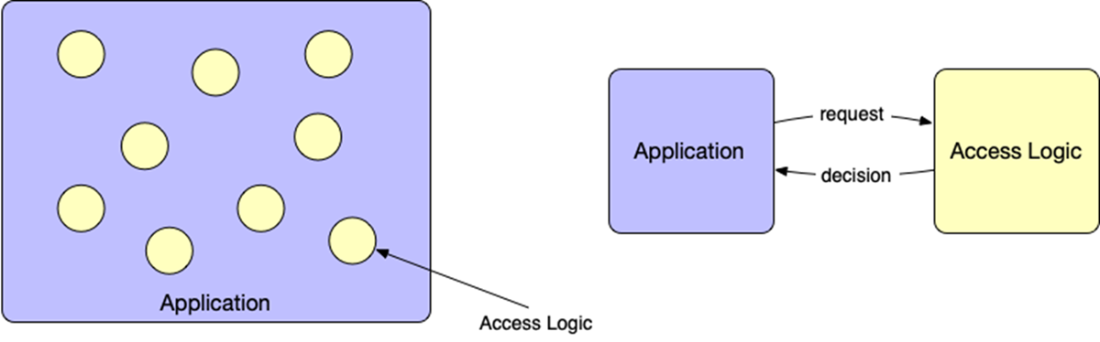
Embedding access logic throughout application code (left) creates tight coupling. Externalizing authorization into a separate component (right) makes access policies explicit, decouples decision-making from application behavior, and enables scalable, auditable access control.
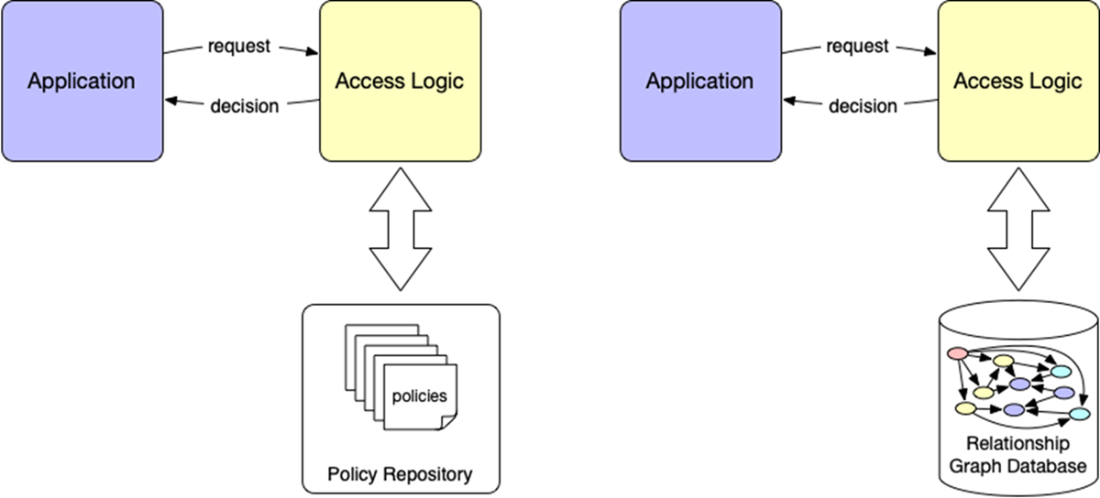
Dynamic authorization can represent policy in two complementary ways. On the left, Policy as Code stores machine-readable policies in a repository that the access logic evaluates at runtime. On the right, Policy as Data stores relationships and attributes in a structured data store that the same access logic uses to determine decisions. Both approaches externalize policy from the application while supporting different kinds of flexibility.
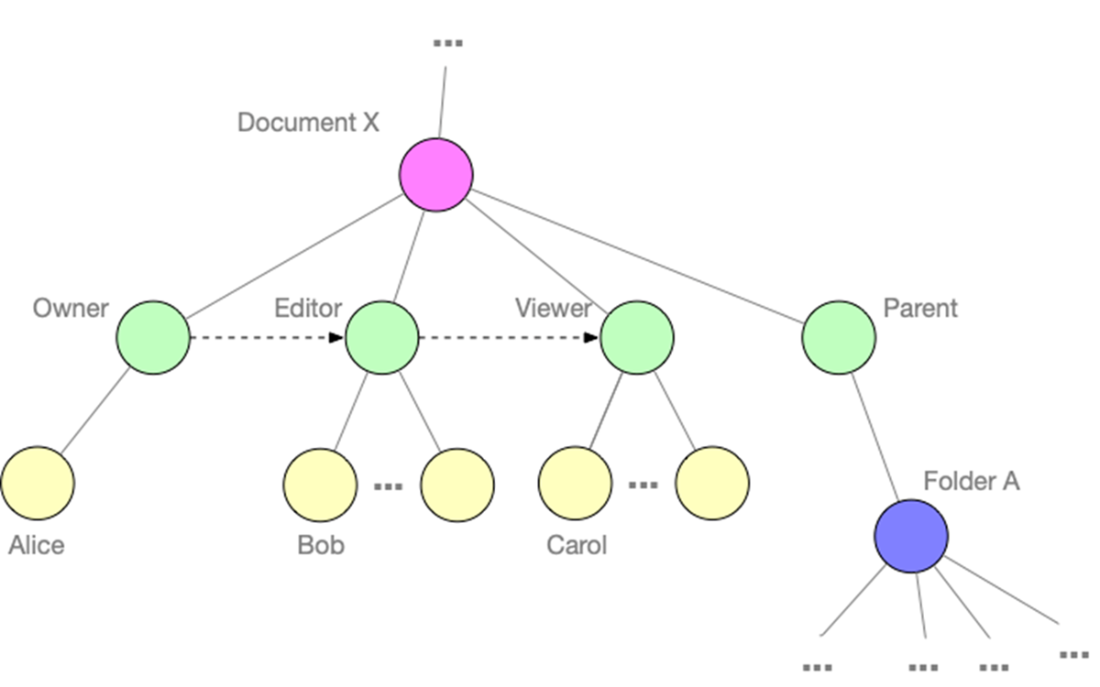
A relationship graph representing access to a Google document. Rather than use static ACLs, this model captures roles (like Owner, Editor, Viewer) as first-class relationships between users and resources. The graph also models hierarchical relationships (such as parent folders), enabling more flexible, general-purpose authorization logic that can be queried and evaluated dynamically.
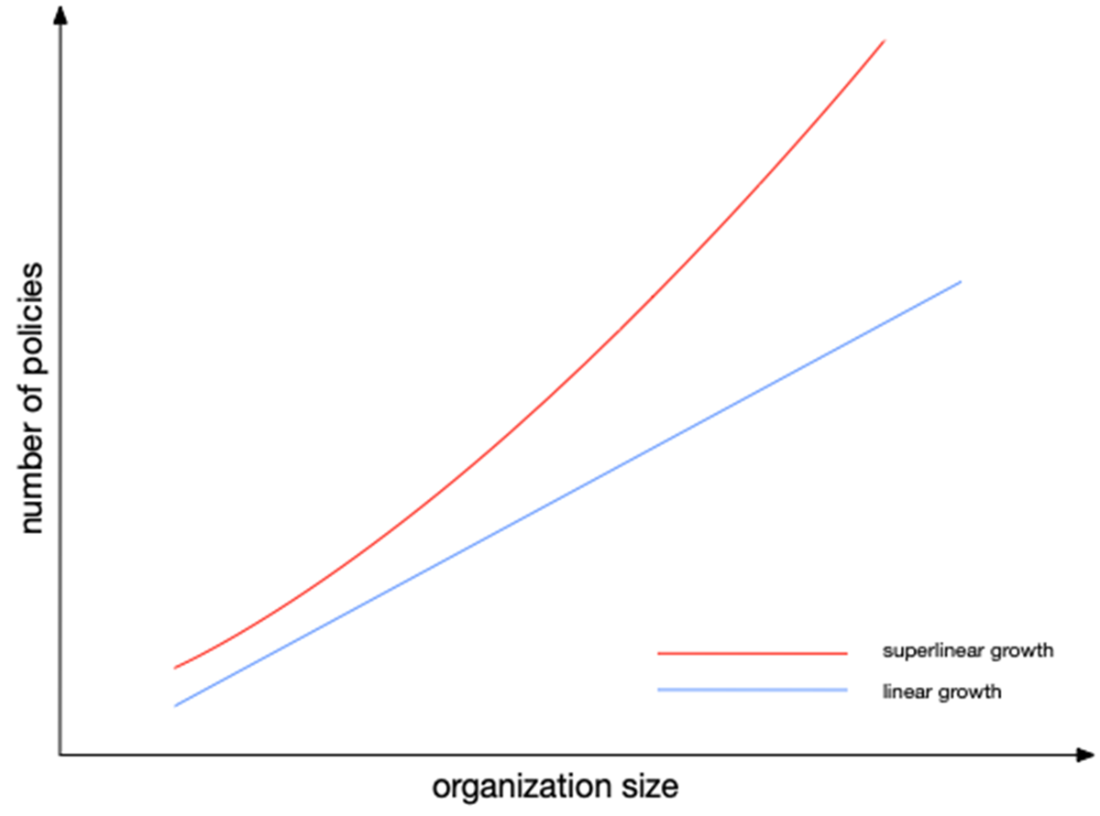
As an organization grows, the number of access policies tends to increase faster than linearly. Though a small organization might manage with a simple, flat set of policies, larger organizations face compounding complexity due to team structures, regional compliance, and overlapping responsibilities, leading to superlinear policy growth.
Summary
- Poor access control can lead to severe security breaches, as seen in the Target breach, where attackers exploited weak authorization to access sensitive systems.
- Authorization is not just about security; it also enables key features in modern cloud applications, such as document sharing and multi-tenant access control.
- Traditional authorization methods like ACLs and RBAC are static and struggle with scalability, flexibility, maintainability, efficiency, auditability, and security.
- Dynamic authorization overcomes these challenges by using policies to make real-time, context-aware access decisions.
- Policy-based access control (PBAC) enables fine-grained authorization by externalizing access control logic, making it dynamic and adaptable to changing conditions.
- The shift toward zero-trust security models, SaaS applications, IoT, regulatory compliance, and AI-driven applications demands more flexible and scalable access control, making dynamic authorization essential.
- Policies can be represented as code or data, enabling both structured rule enforcement and flexible, real-time access adjustments.
- Treating policy as code allows version control, testing, and automation, while policy as data supports fine-grained, user-defined access controls.
- Organizations adopting dynamic authorization benefit from reduced operational costs, improved agility, enhanced security, and better customer experiences.
- Businesses can use dynamic authorization as a competitive advantage, enabling new product capabilities, faster compliance adaptation, and stronger security.
- Authorization is a strategic investment, not just a security measure—organizations that adopt policy-based access control gain efficiency, scalability, and security.

 Authorization in Action ebook for free
