Overview

2 Risk Management

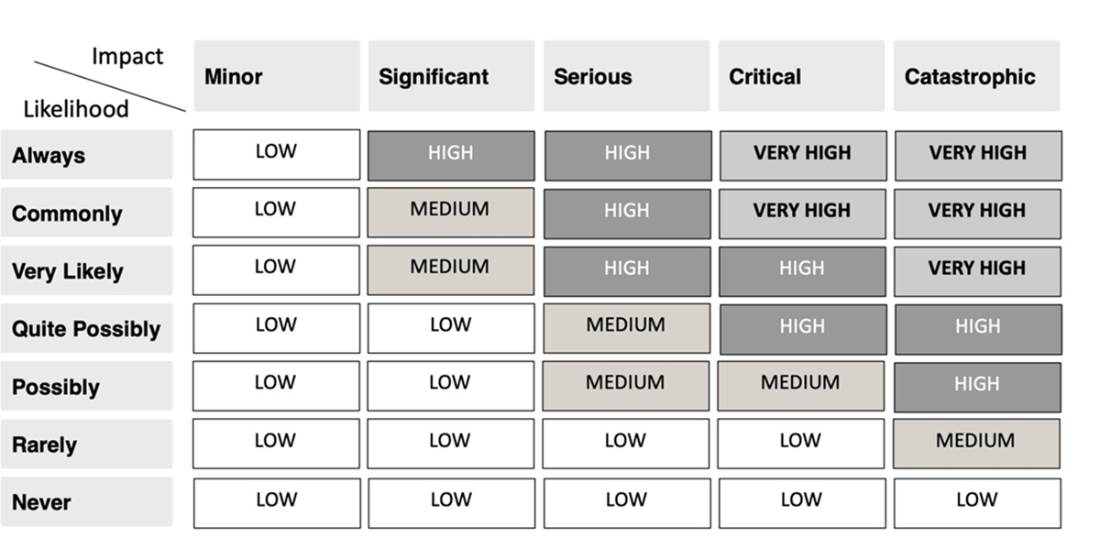
Organizations cannot protect every asset against every threat with unlimited resources, so this chapter frames cybersecurity as a risk-based discipline. It defines risk as the combination of how much harm an event could cause (impact) and how likely it is to occur (likelihood). Impact spans more than monetary loss, covering operational disruption, regulatory penalties, reputational damage, and effects on third parties; likelihood is often estimated using practical ranges rather than precise probabilities. By combining these dimensions—often visualized in a risk matrix or expressed mathematically—teams can compare vulnerabilities and focus first on those that present the greatest overall risk.

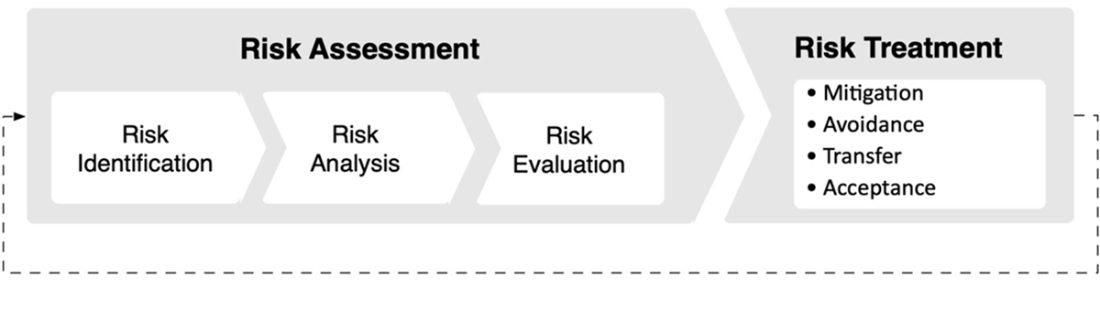
Risk management is presented as an ongoing process with two stages: assessment and treatment. Assessment begins with risk identification, which relies on accurate and regularly updated asset inventories and clear assignment of asset and risk owners. Risk analysis then estimates impact and likelihood using quantitative methods (for example, asset value, exposure factor, single loss expectancy, annualized rate of occurrence, and annualized loss expectancy) or qualitative methods (descriptive scales and a risk matrix), or both. Risk evaluation prioritizes the results, generally breaking ties in favor of higher-impact scenarios and elevating any threat to human safety, so that limited resources address the most consequential risks first.

Risk treatment selects proportionate strategies—mitigate, avoid, transfer, or accept—guided by cost/benefit considerations, organizational risk appetite, and specific risk tolerances for business functions. Because no control set eliminates all exposure, residual risk must be acknowledged and either accepted or further reduced, and teams should recognize that new controls can introduce new risks. Effective practice requires documented treatment plans, clear communication with risk owners, integration with daily operations, and continual reassessment as assets, threats, and business priorities evolve, ensuring security investments deliver the greatest reduction in risk aligned to organizational goals.

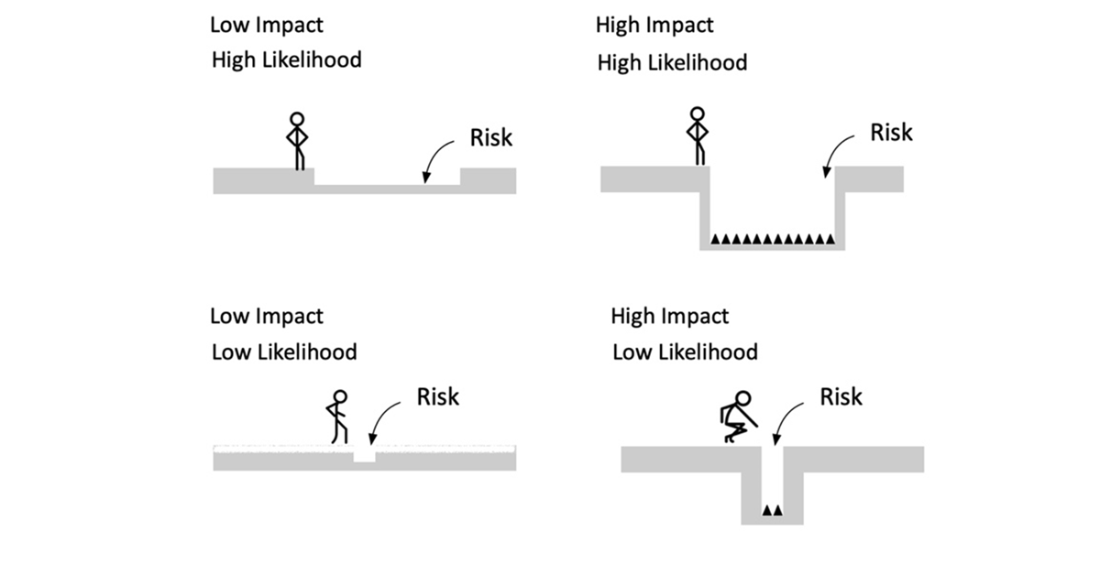
Illustration of the risk in terms of likelihood and impact
Risk as function of likelihood and impact
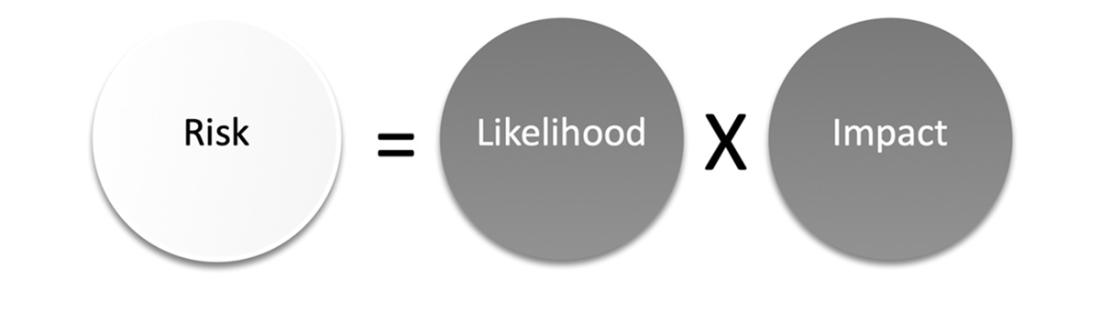
Illustration of the risk management process
A risk matrix displaying the level of risk as a function of the values of likelihood and impact
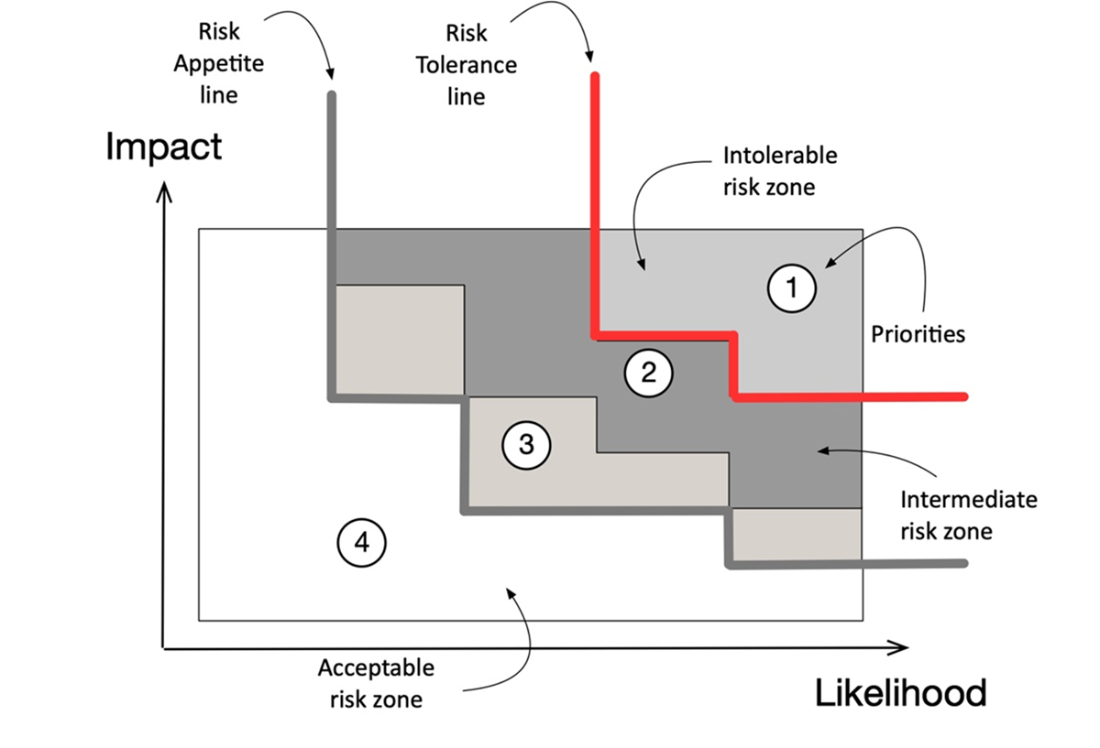
Risk prioritization quadrants according to likelihood and impact
Answers to Review Questions

  1. The correct answer is B. The purpose of any insurance is to transfer risk from one party to another and this process is called risk transference. The insurer is obligated to compensate the insured for a loss caused by an unexpected event over a specified and mutually agreed upon period of time.
  2. The correct answer is A. Risk management is a proactive process of identifying, assessing and prioritizing risks. Appropriate controls are then selected and implemented to reduce or mitigate the potential impact of identified risks. On the other hand, eliminating all risks is impractical, minimizing implementation costs can expose an organization to unnecessary risk, and focusing solely on reactive countermeasures runs counter to the principles of comprehensive risk management.
  3. The correct answer is D. Risk acceptance is a risk management strategy in which an organization chooses not to implement controls to address a risk, but instead accepts the risk and its potential consequences. This doesn't mean that the company ignores the risk; rather, it has made a conscious decision to accept it after considering the costs and benefits.
  4. The correct answer is A. Residual risk helps organizations understand the remaining level of risk they face after implementing their chosen controls and countermeasures, enabling them to make informed decisions about whether additional action is needed or whether the remaining risk is acceptable. None of the other options accurately describe the concept of residual risk.
  5. The correct answer is A. Risk mitigation involves implementing strategies to limit the impact or likelihood of threats occurring. Risk acceptance, on the other hand, is a conscious decision to acknowledge a risk but not take immediate action.

FAQ

What is “risk” in cybersecurity?Risk is the potential for harm calculated by combining how likely an adverse event is (likelihood) with how severe its consequences would be (impact). As either likelihood or impact increases, overall risk rises.
What’s the difference between impact and likelihood?- Impact: how much harm an event would cause (to assets, operations, reputation, compliance, and affected third parties). - Likelihood: the probability or expected frequency that the event will occur. Effective prioritization considers both together, not just one.
How do organizations estimate likelihood in practice?Exact probabilities are hard to determine, so teams use broad, discrete frequency ranges (for example: several times a year, once per year, once every few years). They also factor in ease of exploitation, system exposure, attacker interest, and existing controls.
How should risks be prioritized?Start with the combined risk (likelihood × impact). If multiple risks fall into the same level, prioritize higher-impact items first—especially anything that could affect safety or cause severe business harm—even if its likelihood is lower.
What are the main stages and steps of the risk management process?- Risk assessment: identify assets and risks (risk identification), analyze them (qualitative and/or quantitative risk analysis), then evaluate and prioritize them (risk evaluation). - Risk treatment: select and implement strategies to handle prioritized risks, considering organizational constraints and policies.
What is risk identification and why are asset inventories essential?Risk identification catalogs vulnerabilities, threats, and current controls across all assets. Accurate, regularly updated inventories (hardware, network/communications, software, data/legal obligations, physical facilities, suppliers/third parties) let you find risks where they actually exist and assign clear ownership.
What’s the difference between qualitative and quantitative risk analysis?- Quantitative: uses numbers (e.g., costs, probabilities) to model loss and compare options objectively (useful when reliable data exists). - Qualitative: uses descriptive scales (e.g., Low/Medium/High, risk matrix) and expert judgment (useful when data is scarce or impacts are subjective, like reputation).
How do you calculate ALE (Annualized Loss Expectancy)?Use: SLE = AV × EF, then ALE = SLE × ARO. Example: Asset value (AV) $10,000, exposure factor (EF) 40% → SLE $4,000. If annualized rate of occurrence (ARO) is 0.5, then ALE = $4,000 × 0.5 = $2,000 per year.
What’s the difference between risk appetite and risk tolerance?- Risk appetite: the overall amount of risk leadership is willing to accept to meet business goals. - Risk tolerance: the specific, acceptable level of risk within a given area or activity, staying within the broader appetite.
What are the four risk treatment options and how do you choose?- Mitigate: reduce likelihood and/or impact (e.g., controls like MFA, encryption). - Avoid: stop or change the risky activity (e.g., retire an unsupported system). - Transfer: shift financial impact to a third party (e.g., insurance). - Accept: consciously tolerate the residual risk. Choose based on cost–benefit, risk levels, and organizational tolerance—and remember treatments can introduce new or changed risks that must be monitored.

pro $24.99 per month

  • access to all Manning books, MEAPs, liveVideos, liveProjects, and audiobooks!
  • choose one free eBook per month to keep
  • exclusive 50% discount on all purchases
  • renews monthly, pause or cancel renewal anytime

lite $19.99 per month

  • access to all Manning books, including MEAPs!

team

5, 10 or 20 seats+ for your team - learn more


choose your plan

team

monthly
annual
$49.99
$499.99
only $41.67 per month
  • five seats for your team
  • access to all Manning books, MEAPs, liveVideos, liveProjects, and audiobooks!
  • choose another free product every time you renew
  • choose twelve free products per year
  • exclusive 50% discount on all purchases
  • renews monthly, pause or cancel renewal anytime
  • renews annually, pause or cancel renewal anytime
  • Become ISC2 Certified in Cybersecurity ebook for free

choose your plan

team

monthly
annual
$49.99
$499.99
only $41.67 per month
  • five seats for your team
  • access to all Manning books, MEAPs, liveVideos, liveProjects, and audiobooks!
  • choose another free product every time you renew
  • choose twelve free products per year
  • exclusive 50% discount on all purchases
  • renews monthly, pause or cancel renewal anytime
  • renews annually, pause or cancel renewal anytime
  • Become ISC2 Certified in Cybersecurity ebook for free