1 Using generative AI in web apps
Generative AI web apps weave advanced models—especially large language models—into everyday interfaces to create text, images, audio, and video on demand. This unlocks dynamic, personalized, and conversational experiences that reshape how products are built and used, from intelligent automation to entirely new interaction patterns. The chapter sets the stage for building real, production-ready apps, outlining the stack and practices used throughout the book: React and Next.js for the front end and backend, the Vercel AI SDK for model integration, leading providers such as OpenAI and Google AI, and the Model Context Protocol for secure tool and data access. With only basic JavaScript and React prerequisites, the focus stays on practical concepts for designing, developing, and deploying AI-powered experiences.
After surveying what generative AI can do—text, image, multimedia, and code generation; content enhancement; problem solving; and creative exploration—the chapter illustrates concrete use cases: a marketing toolbox for image and copy creation, customer support with chatbots and sentiment-aware replies, and a mock interview platform driven by voice-enabled AI agents and adaptive feedback. The book’s hands-on approach builds skills through focused projects, culminating in two portfolio-grade applications: an interview assistant that records voice input and generates tailored feedback, and a corporate knowledge system powered by Retrieval-Augmented Generation.
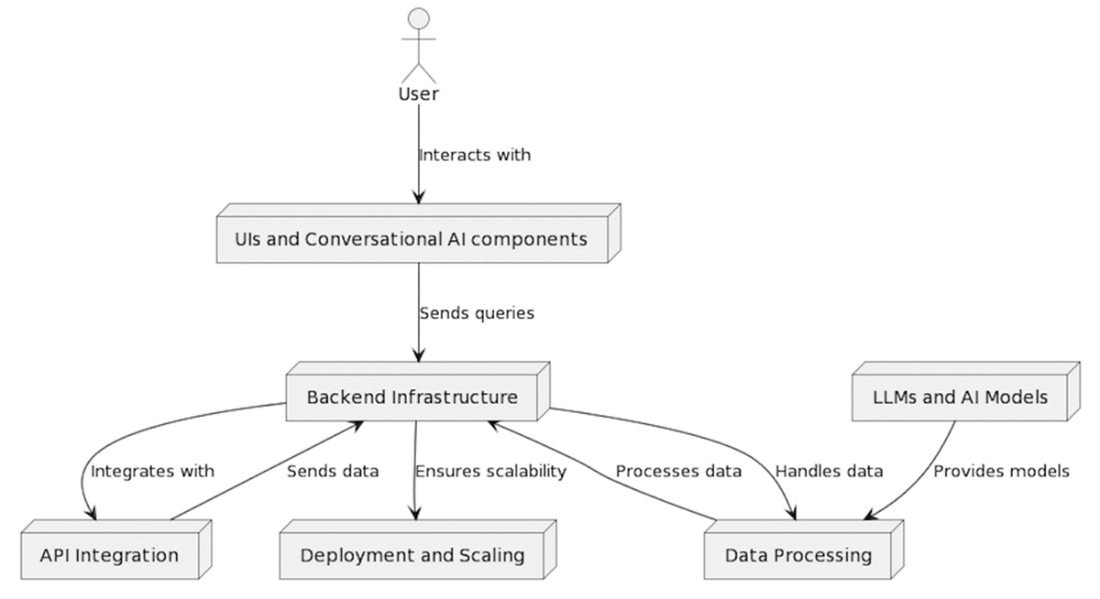
The chapter also demystifies how these apps work end to end: users interact through UI and conversational components; backends handle preprocessing, safety, routing, and model calls; data pipelines shape inputs and outputs; and infrastructure such as caching, serverless functions, and orchestration ensures reliability and scale. It compares model choices and hosting strategies—LLMs alongside GANs, transformers, VAEs, and RNNs; pre-trained services versus self-hosting; and performance factors like latency and cost—while explaining why transformers and self-attention enable today’s context-aware generation. Finally, it addresses responsibilities and risks: limits in accuracy and coherence, resource demands, security and misuse, compliance with privacy regulations, and bias. Practical guidance emphasizes validation, careful prompt and context design, auditing for bias, strong UX patterns like streaming responses and multimodal inputs, and an overall commitment to safe, reliable, and user-centered applications.
The flow of information and interactions between the key components of a generative AI web application.
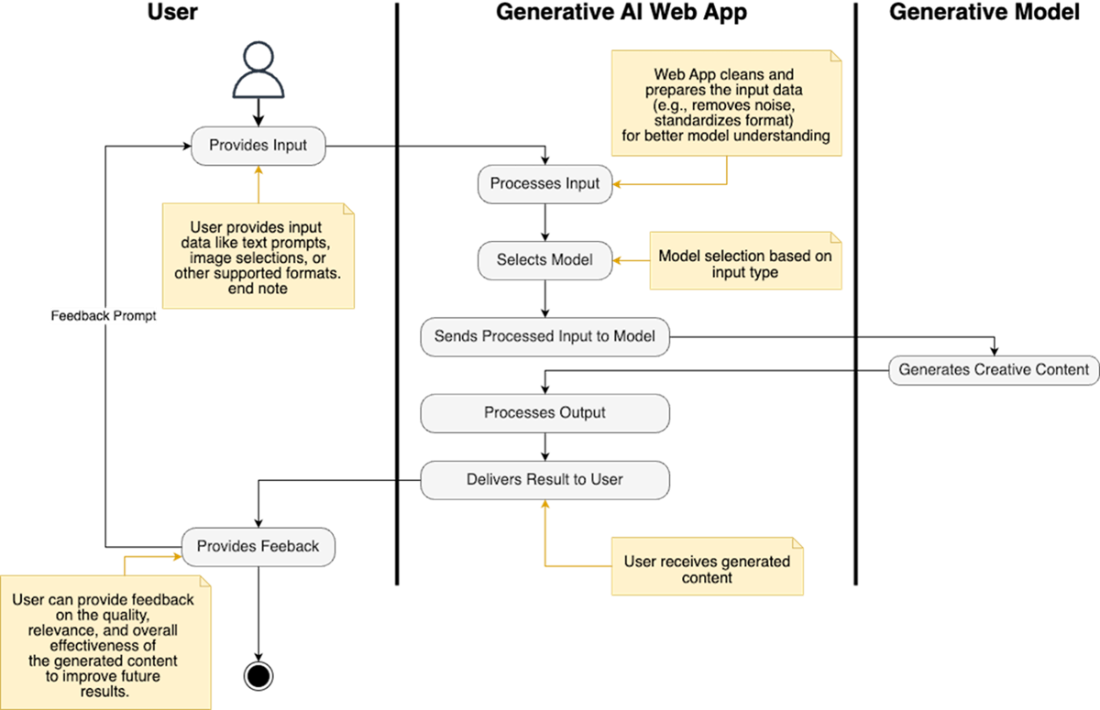
How an AI web app works: users input data, the app processes it, selects a model, generates content, delivers it, and optionally collects feedback.
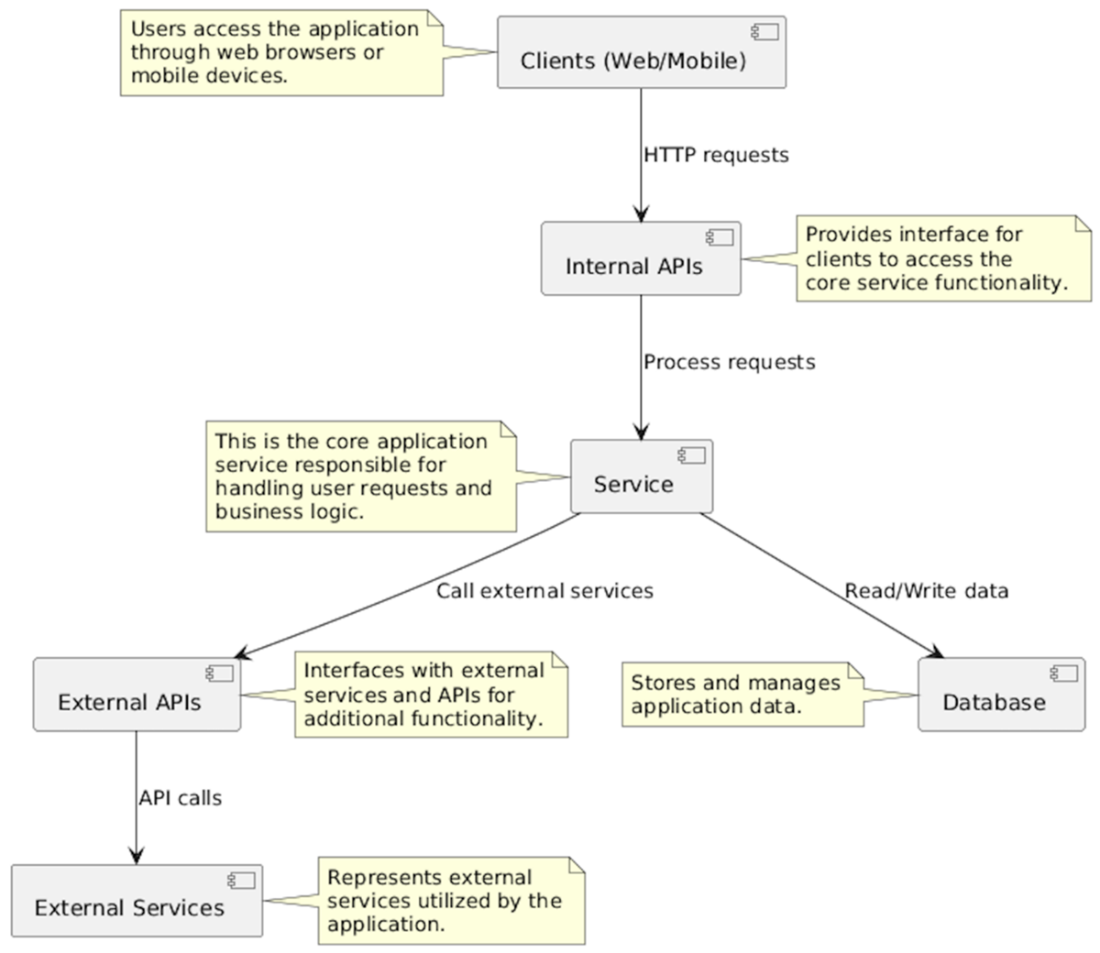
Simplified architecture diagram of a web application ecosystem. Clients, including web browsers and mobile devices, interact with the core application service, which handles user requests and business logic. The service interacts with a database to store and manage application data. Additionally, the service communicates with external APIs to access additional functionality and interacts with external services utilized by the application.
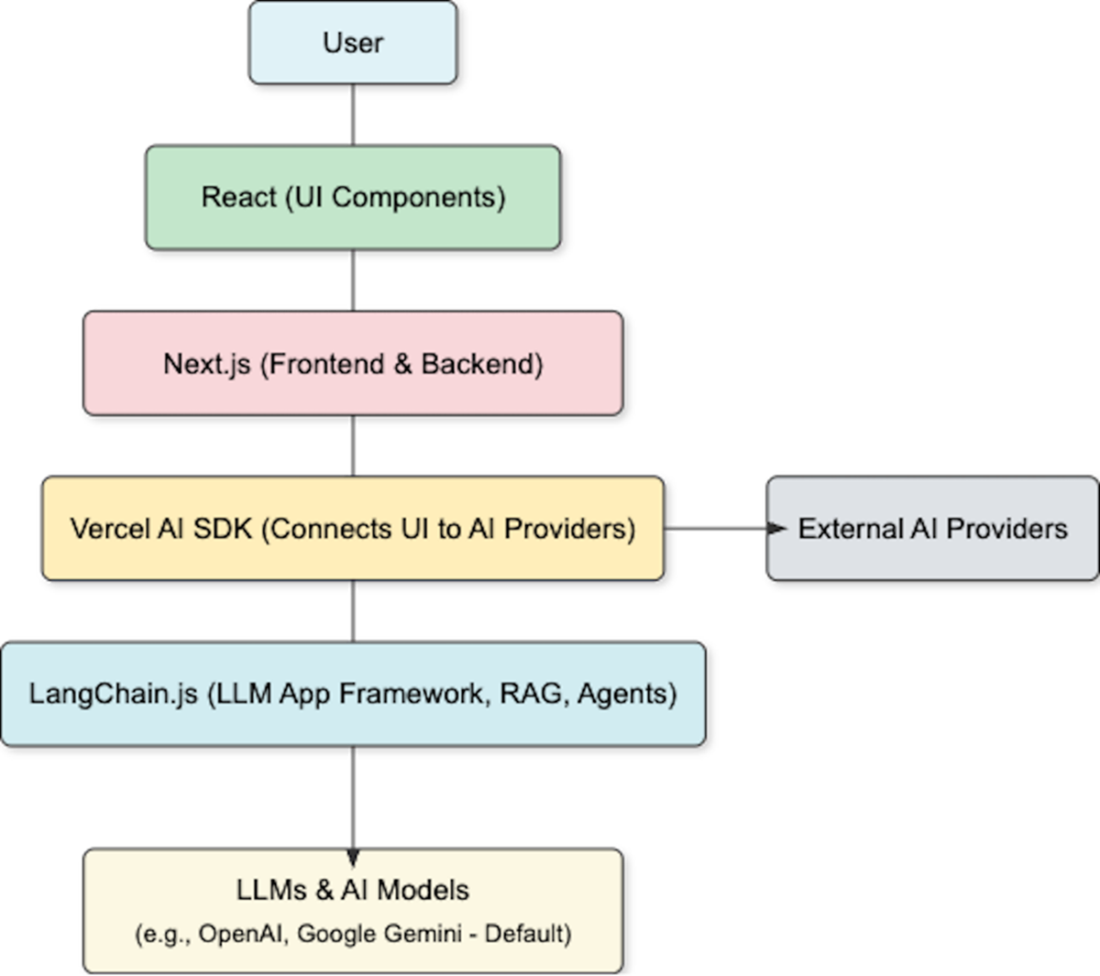
Leveraging key technologies to create generative AI web applications
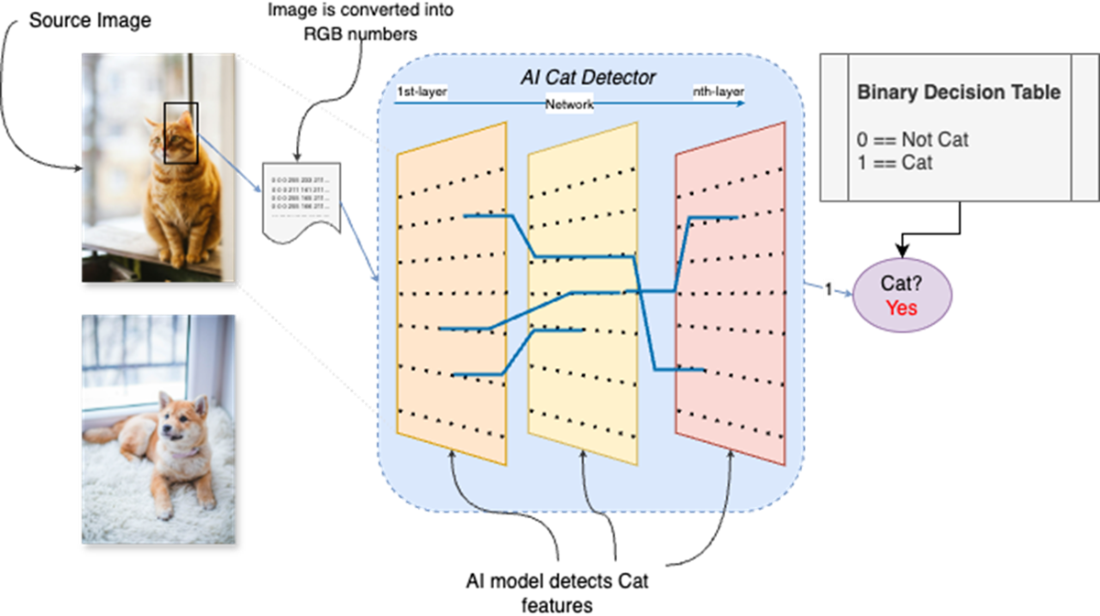
How AI can be used to detect whether a picture of a cat is a cat or not. It accepts an image as input and responds with yes or no (or 0 and 1).
Summary
- Generative AI can generate not only text, but all sorts of media resources like images, video clips and audio. This greatly enhances their potential usage in web applications, and real-world uses of generative AI in web applications range from digital marketing and customer experience management to mock interview applications.
- Generative AI web apps center on powerful models like large language models (LLMs) to create content from user input. The apps require a full supporting ecosystem to integrate with the model, including UI and conversational AI components, backend infrastructure, data processing pipelines, API integration, and deployment and scaling mechanisms.
- The apps we build in this book will use JavaScript and React to display the UI interface components, along with Next.js and the Vercel AI SDK to manage the backend and interact with external AI service providers.
- Choosing the right model for an app is a key architectural decision and depends on the task required. Different model types ( such as LLMs, GANs, autoregressive, transformers, VAE, and RNNs) excel at different kinds of problems. But the model architecture is just one consideration; developers also need to consider the quality and type of data it was trained on.
- Software engineers have been using AI long before generative AI came into existence. Common applications include machine learning, search recommendations, chatbots and computer vision.
- Foundational research like Google's "Attention is All You Need" laid the groundwork for transformative technologies such as transformers, which simplified natural language processing tasks by leveraging attention mechanisms. Transformers revolutionized language modeling by improving efficiency and accuracy in understanding textual data, addressing long-standing challenges faced by traditional AI models.
- Limitations of generative AI include quality control issues, resource intensiveness, security concerns, and regulatory compliance. Concerns include its potential impact on jobs, the reliability of outputs, handling bias, and enhancing the user experience.
FAQ
What is a generative AI web application?
A generative AI web app integrates advanced models—most commonly large language models (LLMs)—to create original text, images, audio, or video. Instead of relying solely on predefined logic, it generates content dynamically to deliver personalized, adaptive, and conversational experiences. This enables features like chat interfaces, intelligent automation, and new application categories.
How does generative AI differ from traditional AI?
Traditional AI often classifies or recognizes patterns (e.g., “cat vs. not cat”), while generative AI learns underlying patterns deeply enough to produce new content. Breakthroughs like transformers and self-attention let models understand context and long-range dependencies, enabling coherent, context-aware generation across text, images, and more.
What capabilities can generative AI add to a web app?
Common capabilities include text generation (content, chat), image generation and transformation, multimedia creation (video, music), code generation, exploratory creativity, problem solving across domains, and content enhancement (editing, style transfer, refinement).
What are some real-world use cases highlighted in the chapter?
Examples include a digital marketing toolbox for text-to-image and image-to-image workflows; customer experience platforms using chatbots and sentiment-informed responses; and mock interview apps with AI interviewer agents, speech-to-text, personalized scenarios, and adaptive difficulty.
How does a generative AI web app work end-to-end?
The typical flow is: (1) user input via the UI, (2) backend processing and model selection, (3) content generation via internal/external APIs, and (4) response delivery with an optional feedback loop. This collaboration between user, app, and model iteratively improves results and UX.
What are the core components of the architecture?
Key components include LLMs and domain-specific models; UIs and conversational agents; backend infrastructure (caching, containerization/orchestration, serverless, model serving); data processing (pre/post-processing, feature extraction); API integrations; and deployment/scaling mechanisms.
Which tools and stack does the book use?
The book builds with JavaScript, React (UI), Next.js (backend/data fetching), and the Vercel AI SDK (provider-agnostic AI integration). It primarily uses Google Gemini with occasional OpenAI models, and leverages LangChain.js for RAG chatbots. Later chapters introduce the Model Context Protocol (MCP) for secure tool/data access.
How do I choose the right model for my app?
Match model type to task: LLMs/transformers for text, GANs/VAEs for imagery, autoregressive models for sequences (e.g., code, music), with RNNs suited to smaller sequential tasks. Decide between pre-trained APIs vs. self-hosted models, then evaluate latency, resource needs, and your app’s UI, pre-processing, and post-processing requirements.
What limitations and risks should I plan for?
Expect quality control challenges (accuracy, coherence), resource intensiveness (compute/cost), security concerns (misuse, misinformation), and regulatory obligations (GDPR/CCPA, PII handling, IP/content authenticity). Build safeguards for privacy, safety, and compliance into design and operations.
Are AI outputs reliable, and how can I validate and reduce bias?
Outputs are probabilistic and can hallucinate. Improve reliability by setting clear objectives, constraining context, tuning model parameters, cross-validating, and adding robust validation steps (e.g., RAG). Mitigate bias by restricting knowledge bases, selecting models trained on diverse data, and conducting systematic bias audits.

 Build AI-Enhanced Web Apps ebook for free
