1 What is BDD?
Software development is a socio-technical conversation, not just code. Behavior-Driven Development (BDD) aims to capture that evolving conversation in a precise, testable form that guides delivery and keeps business intent aligned with implementation. The chapter frames three persistent industry problems—incomplete requirements, unreliable documentation, and slow or noisy feedback—and positions BDD as an approach that creates a durable, automated connection between current requirements and system behavior, enabling fast, meaningful feedback at the level of business intent.
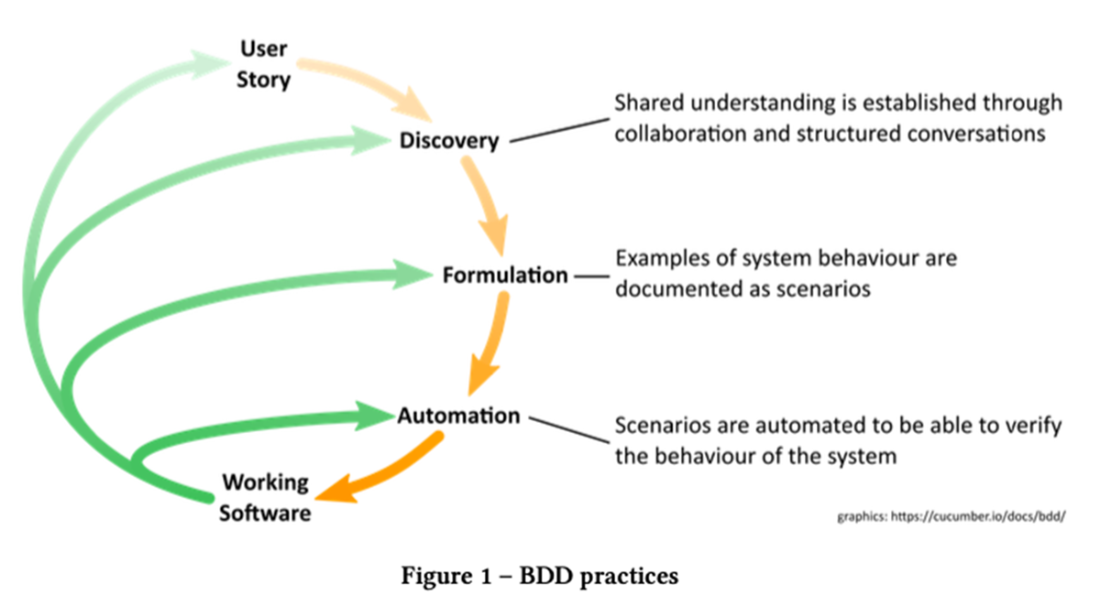
BDD is an agile, collaboration-first approach composed of three core practices: discovery, formulation, and automation, applied to small, valuable slices of functionality described by user stories. In discovery, cross-functional teams explore rules through concrete examples in requirement workshops; in formulation, those examples become business-readable scenarios (often using Given/When/Then and Gherkin) that stakeholders can review; in automation, scenarios are wired to executable tests (via tools such as Cucumber or Reqnroll) that drive implementation and become living documentation. BDD complements TDD: scenarios define the outer “behavior” loop, while unit-level TDD implements the inner loop, yielding fast feedback, reduced rework, and a persistent specification that evolves with the product. Testers remain essential, especially for discovery and exploratory verification, even as more regression checking becomes automated.
Adoption succeeds when collaboration is real and scenarios are readable and maintainable. Common pitfalls include “BDD without the business,” automation in isolation after the fact, meandering or opaque scenarios, and brittle automation; naming debates (BDD, ATDD, SbE) matter less than practicing the underlying techniques. The chapter recommends evolving rather than transforming overnight: start early in the flow with better discovery, improve role interfaces, run small experiments, and scale only after results are proven. BDD is neither a free lunch nor a silver bullet—it demands engaged stakeholders and disciplined code quality—but when done well it delivers less waste, fewer defects, faster, more reliable feedback, and living documentation that sustains maintainability over time.
BDD is an agile approach to delivering software that introduces three core practices
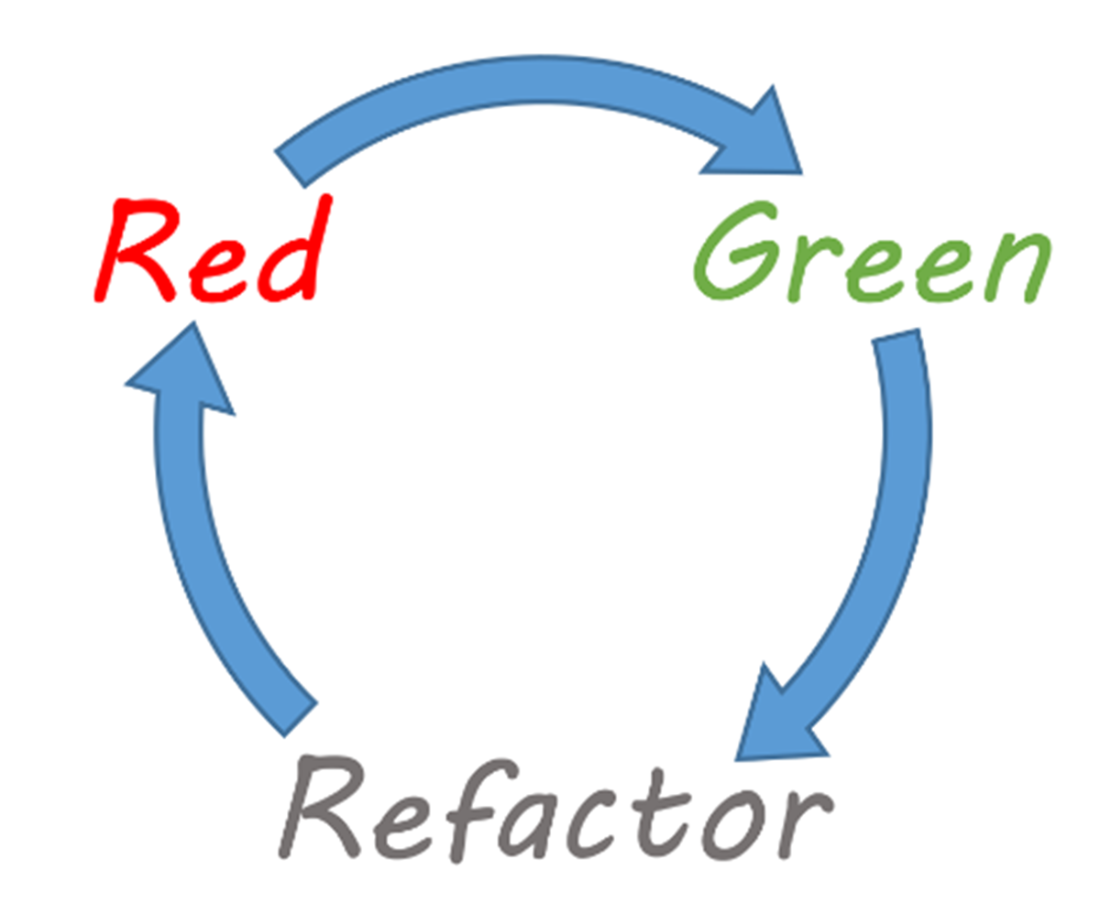
The TDD cycle starts by writing a test and seeing it fail (Red). Then we write just enough code to have the test pass (Green). Finally, we refactor the code to improve its structure
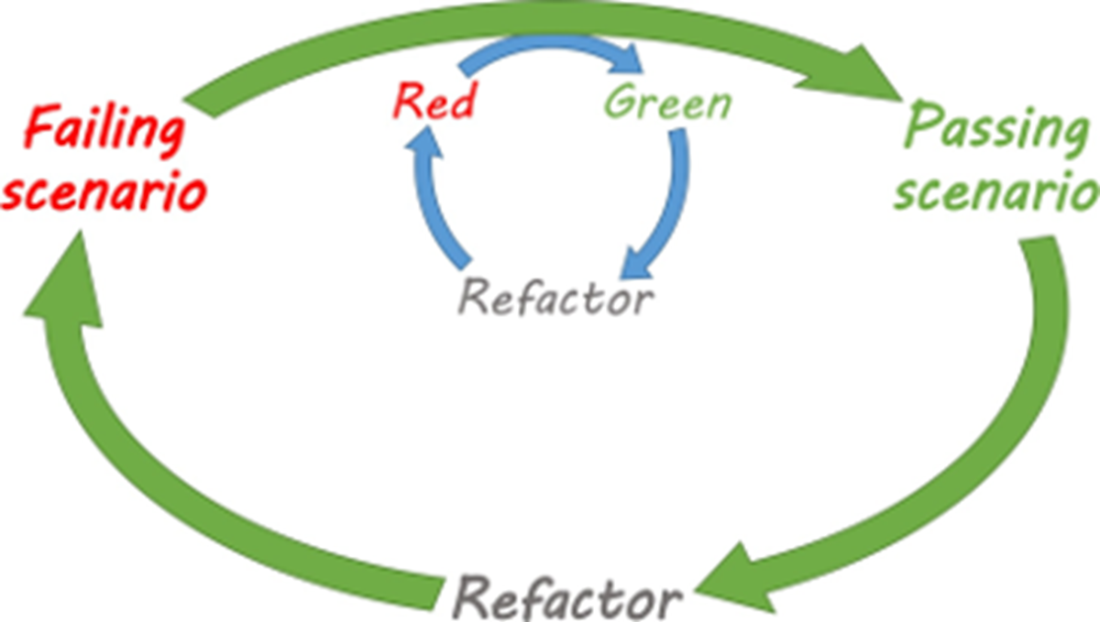
The BDD cycle is the outer loop – write a failing scenario, get the scenario to pass, then refactor. We enter the inner, TDD cycle to implement the code needed to move from a failing scenario to a passing scenario.
Summary
- Modern software development processes suffer from incomplete requirements, unreliable documentation, and slow feedback.
- Behavior Driven Development (BDD) maintains the connection between the requirements and the software by using examples that describe how the system should behave. These examples are called scenarios when expressed in business language.
- There are many tools that can interpret scenarios and directly execute them as tests of the software being developed.
- Each user story describes several rules. Each rule should be illustrated by one or more scenarios, and each scenario helps us explore our understanding of the rule.
- BDD follows the same Red/Green/Refactor cycle as TDD, but at the level of the scenario. Developers use the TDD cycle when getting a failing scenario to pass.
- BDD does not remove the need for traditional software testing, but it reduces the team’s reliance on it by ensuring that most misunderstandings are dispelled before any code is written.
- By collaborating on the creation of the scenarios, the team creates documentation that can be understood by all stakeholders.
- Scenarios, when run as tests, become living documentation of the software that is being built. Living documentation automatically informs the team when the software implementation diverges from the behavior documented by the scenarios.
- BDD is an agile approach to developing software, consisting of three practices: Discovery, Formulation, and Automation.
- BDD adoption is challenging, but there are techniques that can help an organization succeed.
FAQ
What is Behavior-Driven Development (BDD)?
BDD is a collaborative approach to understanding, documenting, and verifying business requirements through illustrative examples and scenarios. It keeps business and technical people aligned by expressing expected behavior in business-readable language that also guides implementation.Which problems in software development does BDD address?
- Incomplete requirements: prevents gaps and misinterpretations by refining needs through examples.- Unreliable documentation: links specifications to executable tests, keeping docs current.
- Slow feedback: automates scenario checks to provide fast, meaningful, requirement-level feedback.
How does BDD relate to Test-Driven Development (TDD)?
BDD emerged as a refinement of TDD to keep tests connected to business intent. In practice, BDD’s outer loop uses business-readable scenarios to drive development, while the inner loop often uses TDD (red-green-refactor) to implement the code needed for those scenarios.What are the core BDD practices and in what order are they applied?
- User stories: lightweight placeholders for value-focused functionality.- Discovery: collaborative workshops to explore rules via concrete examples.
- Formulation: turn examples into business-readable scenarios (often Gherkin).
- Automation: implement code that executes scenarios as tests, yielding living documentation.
- Working software: deliver the implemented behavior to users.

 Effective Behavior-Driven Development ebook for free
