1 Recommender systems in action
Recommender systems are algorithms that order items—movies, products, posts—so the most relevant rise to the top in a world overloaded with choices. Built increasingly with machine learning, they infer preferences from past behavior and turn those signals into new recommendations. Because user actions feed the system and the system’s outputs shape user actions, people and algorithms form a tight feedback loop that can be helpful for discovery yet also nudge behavior over time, sometimes toward more extreme or sensational content. This chapter introduces that loop, explains why recommender systems are now embedded in most digital experiences, and frames recommendation as a powerful force that allocates attention.
Social media is the clearest stage on which these forces play out. Feeds evolved from simple chronological lists to personalized ranking, and then to fully algorithmic timelines that insert out-of-network content the system predicts will engage each user. Platforms increasingly optimize for engagement, aligning business incentives with designs like infinite scroll and autoplay. The result is a mix of benefits and risks: faster news and community organizing alongside filter bubbles, homogenized culture, mis/disinformation, addictive reward cycles, and heightened vulnerabilities for at-risk users. Network effects concentrate power in a few companies whose opaque ranking changes can reshape livelihoods, public discourse, and even democratic processes, while regulation struggles to keep pace.
Because attention is finite, every ranking decision amplifies some content and dampens other content. Measuring that amplification is essential yet difficult: “value” to users is hard to define or observe, engagement is an imperfect proxy, popularity compounds itself, and the user–algorithm relationship evolves over time and at population scale. The chapter motivates “algorithmic amplification” as a practical lens for transparency—akin to nutrition labels for feeds—and argues that both content selection (what is eligible to appear) and ranking (the order it appears) must be assessed. Establishing shared, scientifically grounded measures of amplification is a first step toward understanding real-world impacts and restoring human control over systems that increasingly shape culture and opinion.
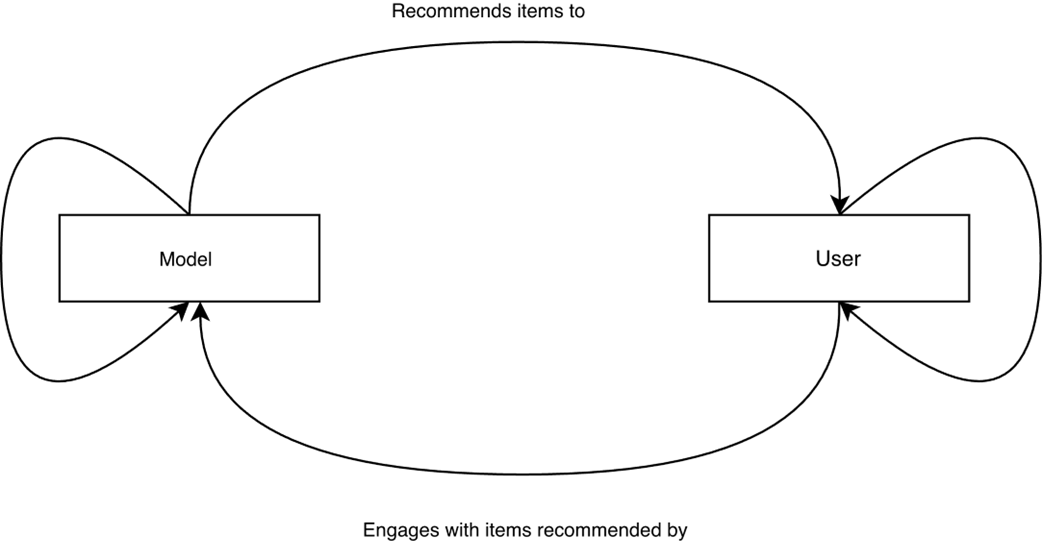
The feedback loop between user and recommender systems. Users and recommender systems are in a mutual feedback loop, with the output of one serving as the input to the other. The output of the algorithm, the recommendations, is the input for the users. The users’ output, what they engage with, is a signal for the recommender. On top of that, both the user and the recommender system update their internal state. Users change their minds and evolve their preferences over time, while algorithms learn users’ preferences and try to align more with them.
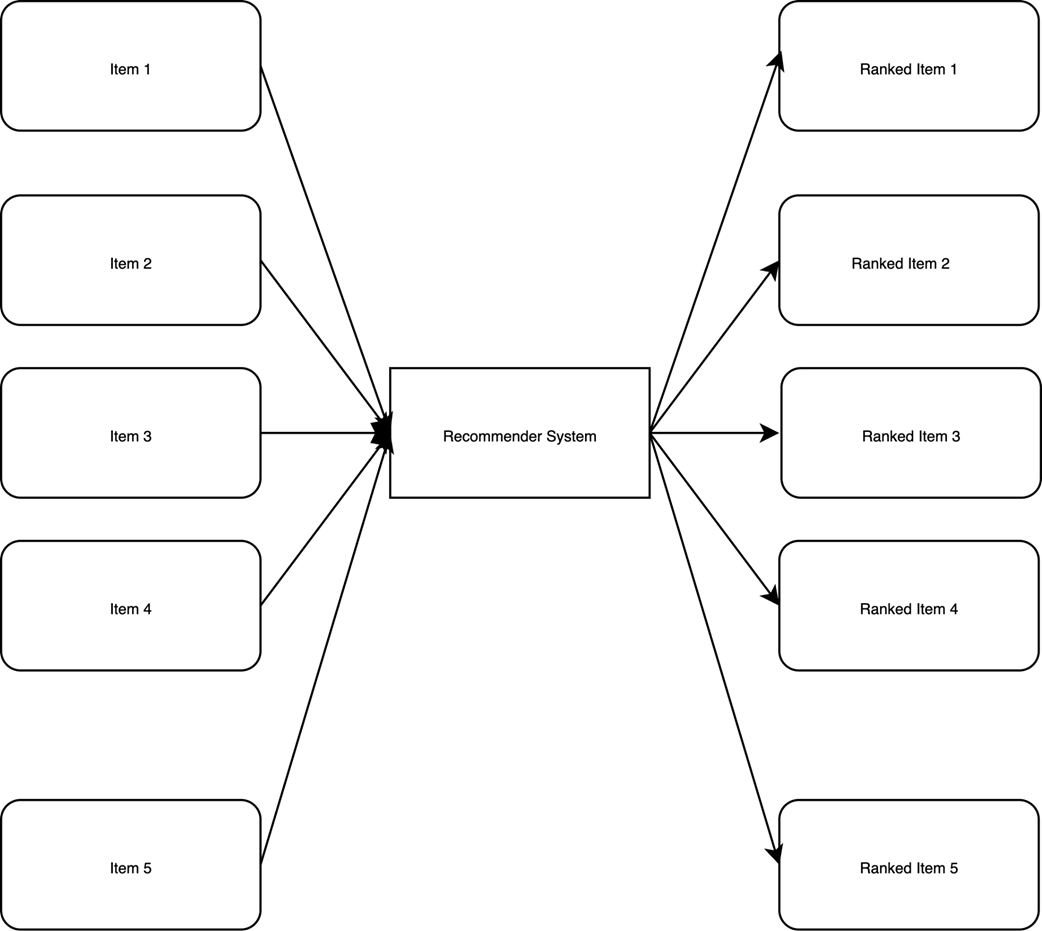
Given a list of items, this recommender system reranks them according to a predefined metric, such as value to the user.
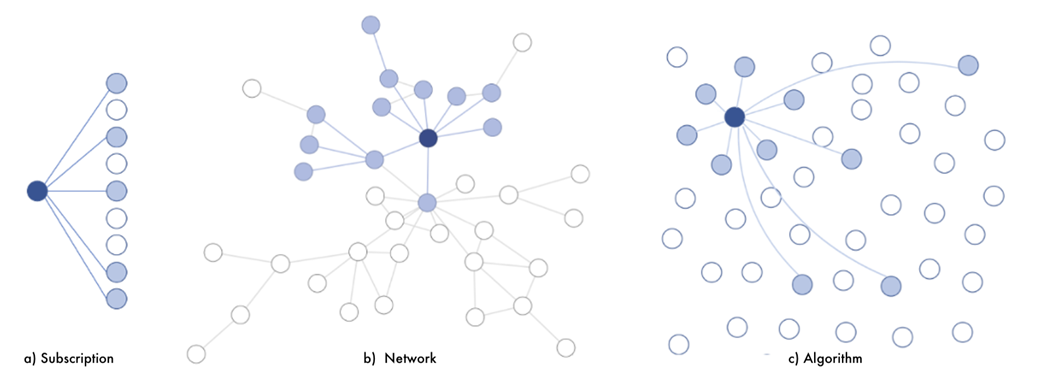
Various social media models. In the Subscription model, the content is seen only by users who explicitly follow the content producer, with no options or resharing. In the Network model, users can also reshare content from users they follow, enabling the distribution of content outside of the immediate network. Finally, in the Algorithmic model, an algorithm can add content to users’ feeds, even with no direct connection to the content itself or its author.
Summary
- Recommender systems are a powerful tool—and often underappreciated as a tool to order vast amounts of information for us. As a technology that pervades every application we interact with, RecSys have the power to influence our preferences in numerous domains, including highly consequential ones such as news consumption, dating choices, and financial decisions.
- Social media was created as a tool to connect people on the internet—at first free of commercial interest—and to build location-free communities around shared interests.
- The evolution of the internet has brought about more online platforms that have been able to connect an unprecedented number of people. Given the high running costs and the investors’ demands, platforms were nudged into finding ways of monetizing such efforts.
- Social media platforms began experimenting with recommender systems as a means to align business and customer interests. By explicitly indicating business goals and taking into account users’ behavior, platforms were able to serve more relevant content to users—which made the users be more active and spend more time on the platforms.
- The use of such algorithms raises important questions about algorithmic amplification, such as understanding which content is amplified more and why. Different types of platform designs enable various approaches to thinking about amplification.

 Hidden Influences ebook for free