This chapter motivates and frames type systems as the layer that gives meaning to raw bits and prevents entire classes of errors before software runs. It defines types as classifications that constrain allowable values and operations, and a type system as the rules that assign, check, and enforce those types—at compile time or at run time. The discussion ties correct typing to real-world reliability and security, highlights the proofs-as-programs insight (types as propositions, programs as proofs), and situates TypeScript within a broader trend: increasingly powerful static type systems and stronger guarantees across mainstream languages.
The core benefits of typing are shown through practical examples. Correctness improves by turning potential run-time failures into compile-time errors and by shrinking the program’s state space so “bad states” become unrepresentable—an effect that also hardens security. Immutability preserves earlier checks and eliminates data races; encapsulation (e.g., private members) protects invariants behind clear interfaces; composability emerges from generic, reusable building blocks (like a parameterized “first” function instead of many ad hoc variants); and readability increases when type signatures communicate intent and constraints, with type inference reducing boilerplate without sacrificing static guarantees.
The chapter contrasts dynamic versus static typing and weak versus strong typing, showing how deferring checks to run time or allowing implicit conversions undermines guarantees, while static, strong typing surfaces errors early and avoids surprising coercions. It explains where inference fits—types are still checked statically even when not written explicitly. Aimed at practicing programmers (with TypeScript examples but language-agnostic lessons), the book promises a practical, low-math tour: starting from primitive types, then composition, function types, and subtyping, advancing to generics for abstraction and reuse, and culminating in higher-kinded types—equipping readers to design safer, more modular, and more understandable systems.
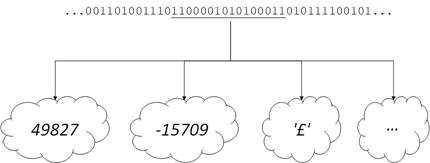
A sequence of bits can be interpreted in multiple ways
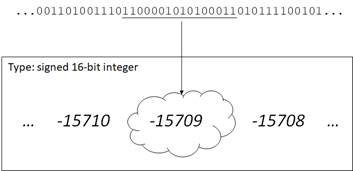
The sequence of bits typed as a signed 16-bit integer. The type information (16-bit signed integer) tells the compiler and/or runtime that the sequence of bits represents an integer value between -32768 and 32767, ensuring the correct interpretation as -15709.
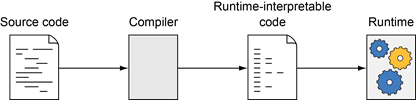
Source code is transformed by a compiler or interpreter into code which can be executed by a runtime. The runtime is either a physical computer or a virtual machine, like Java’s JVM, or a browser’s JavaScript engine.
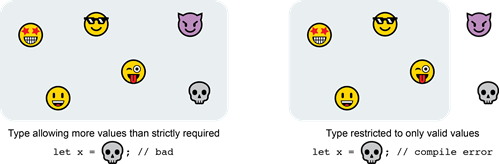
declaring a type correctly we can disallow invalid values: the first type is too loose and allows for values we don’t want (😈, 💀). The second, more restrictive type, won’t compile if the code tries to assign an unwanted value to a variable.
Summary
A type is a classification of data that defines the operations that can be done on that data, the meaning of the data, and the set of allowed values
A type system is a set of rules which assign and enforce types to elements of a programming language.
Types restrict the range of values a variable can take, so in some cases what would’ve been a run-time error becomes a compile-time error
Immutability is a property of the data enabled by typing, which ensures values don’t change when they’re not supposed to
Visibility is another type-level property which determines what components are allowed to access what data
Generic programming enables powerful decoupling and code reuse
Type notations make the code easier to understand for readers of the code
Dynamic typing or “duck typing” determines types at run-time
Static typing checks types at compile time, catching type errors which otherwise would’ve become run-time errors
The strength of a type system is a measure how many implicit conversions between types are allowed
Modern type checkers have powerful type inference algorithms which enables them to determine what are the types of variables, functions and so on without you having to explicitly write them out
In the next chapter we will look at primitive types, which are the building blocks of the type system. We’ll learn how to avoid some common mistakes that arise when using these types and see how we can build pretty much any data structure from arrays and references.
FAQ
Why do programming languages need types?Because computers store everything as bits, the same sequence can be misinterpreted as code or as different kinds of data. Types give meaning to those bits, constrain what values are valid, and define which operations are allowed. By doing so, they prevent entire classes of errors, turning many potential run-time failures into issues the compiler can catch before code runs.What is a “type” and what is a “type system”?A type classifies data by its allowed values, meaning, and valid operations. A type system is the set of rules that assigns and enforces types for variables, functions, and other constructs, either explicitly (via annotations) or implicitly (via inference). It governs which conversions are allowed and ensures programs respect these rules.What is type checking, and how do static and dynamic checks differ?Type checking verifies that code respects the type system’s rules. Static checking happens at compile time (e.g., TypeScript), catching mismatches early and preventing bad programs from running. Dynamic checking happens at run time (e.g., JavaScript), so type errors surface only when the problematic code is executed.What’s the difference between strong and weak typing?Strong typing minimizes implicit conversions; weak typing allows more of them. In a weakly typed setting, "42" == 42 may evaluate to true due to coercion, which can be surprising. Strong typing requires explicit conversions (or rejects mismatches), leading to clearer, safer code and fewer hidden surprises.How do types improve correctness and security?Viewing a type as the set of its possible values, tighter types reduce the state space your program can enter, eliminating “bad states.” This converts many potential run-time errors into compile-time errors (e.g., refusing to pass a number where a string is required). The same restrictions also harden code against common attacks that rely on misinterpreting or executing data.How does immutability help, and how is it enforced?Immutability ensures that once a value is validated, it can’t change behind your back, preserving invariants and preventing subtle bugs, especially in concurrent code. In TypeScript, marking data as const makes mutation a compile-time error, giving the compiler leverage to uphold your assumptions.What does encapsulation have to do with types?Visibility modifiers (public, private) are type-level properties that control what can be accessed from where. By hiding implementation details and exposing only a safe interface, the type system prevents external code from bypassing invariants (e.g., setting a divisor to 0) and reduces cognitive load when reasoning about components.What is composability, and how do generics support it?Composability is the ability to build general pieces that can be reused and combined in many contexts. Generics let you write algorithms parameterized by type (e.g., a first(...) function) so one implementation serves many data types and conditions. This reduces duplication and centralizes changes such as logging or performance improvements.What is type inference, and when should I rely on it?Type inference lets the compiler deduce types from context (e.g., inferring number for let sum = add(40, 2)). It keeps code concise without losing static guarantees. Use it for obvious cases; add explicit annotations when the type would be unclear to readers or when the compiler needs help disambiguating.How are types related to logic (Curry–Howard correspondence)?Curry–Howard connects types with propositions and functions with implications: a value of a type is evidence (a proof) of that proposition. If a program type-checks, it corresponds to a valid proof, lending logical rigor to correctness guarantees. This perspective explains why good type systems can enforce strong, meaningful properties about programs.
pro $24.99 per month
access to all Manning books, MEAPs, liveVideos, liveProjects, and audiobooks!

 Programming with Types ebook for free
