1 Prompt engineering: The blueprint
This chapter frames prompt engineering as a deliberate discipline for software professionals, not a casual messaging habit. It argues that prompts become important when they are shared, reused, or embedded in products, because inconsistent prompt behavior then turns into real defects. In that setting, prompt quality affects reliability, maintainability, and user outcomes in the same way that weak specifications or undocumented APIs do.
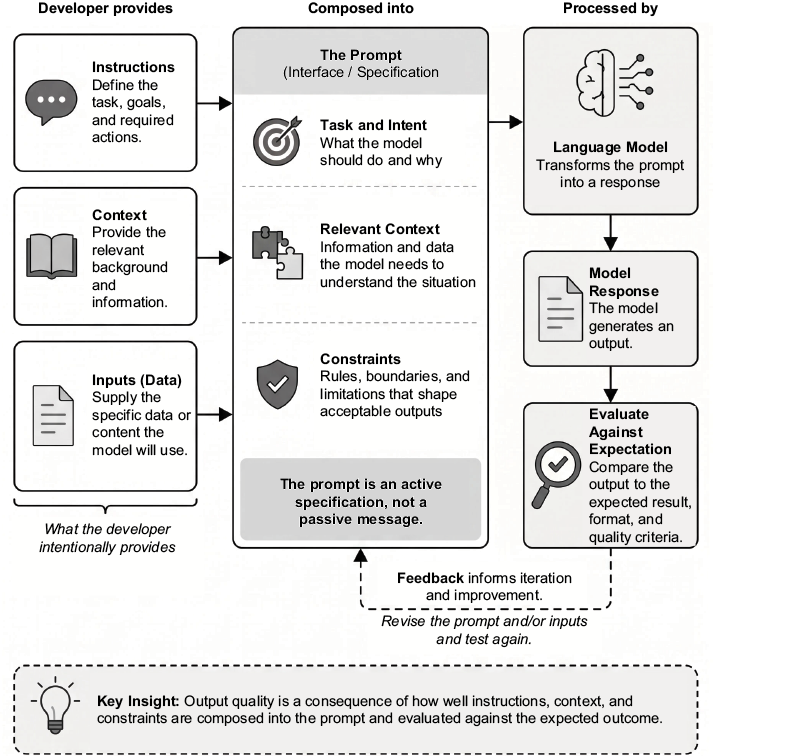
At the center of the chapter is the idea that a prompt is an engineered interface made up of instructions, context, constraints, input data, and expected output. The text contrasts casual prompting with designed prompting by showing how careful structure, explicit boundaries, and output requirements produce more predictable results. It also emphasizes that prompts should be treated as maintainable artifacts that can be reviewed, versioned, tested, and revised over time rather than as disposable chat exchanges.
The chapter also gives a practical workflow and debugging mindset. Prompt work follows four recurring phases: design, test, iterate, and manage, each with a concrete deliverable. When outputs vary or fail, the chapter recommends diagnosing the prompt first by checking the specification, the missing context, and the room left for variability. Together, these ideas establish the foundation for the rest of the book: prompts are first-class engineering objects whose failures can be understood and corrected systematically.
Prompt engineering mental model: Instructions and context enter a prompt, constraints shape the work, and the model response is evaluated against the expected output.
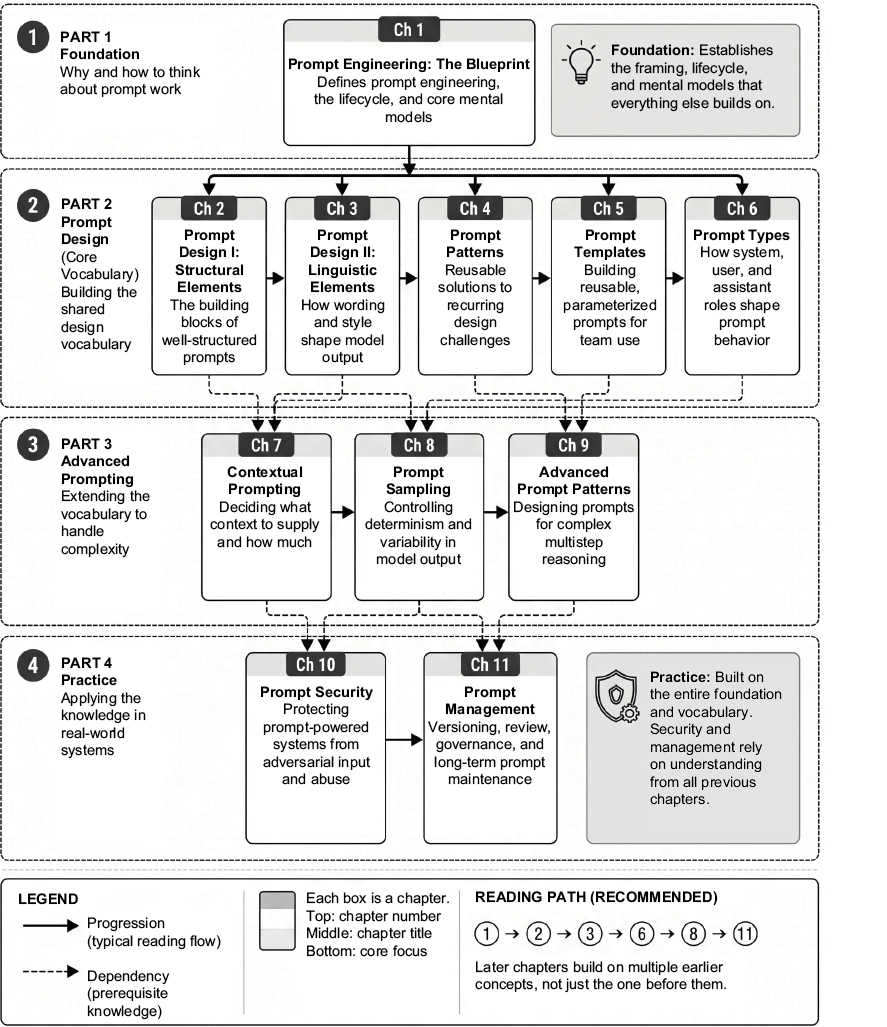
Chapter dependency map: chapter 1 establishes mental models; chapters 2 through 6 build prompt design vocabulary; chapters 7 through 9 extend that vocabulary; chapters 10 and 11 apply it to security and management.
Summary
- Prompt engineering is deliberate interface design. It is the practice of composing, evaluating, and refining prompts to produce reliable outputs, not casual trial and error or model-level modification.
- Prompts in software systems are engineering artifacts. They should be specified, reviewed, tested, versioned, and maintained with the same care as requirements, APIs, and other shared system components.
- Well-designed prompts make the task explicit. They connect instructions, required context, constraints, input boundaries, and the expected output shape so the model has less room to vary in unhelpful ways.
- The prompt engineering lifecycle makes prompt work repeatable. Design produces a prompt draft, testing produces evidence, iteration fixes observed failures, and management preserves ownership and change history.
- Prompt failures are diagnosable. The three diagnostic lenses introduced in this chapter become the foundation for the rest of the book.
FAQ
What is prompt engineering in this chapter, and how is it different from casual prompting?
Prompt engineering is the deliberate practice of composing, evaluating, and refining prompts to produce reliable and predictable outputs. Casual prompting is reactive and one-off, with no clear criteria, review process, or maintenance. The chapter frames prompt engineering as a design discipline, not just typing a request and hoping for the best.Why does the chapter say prompts should be treated as engineering artifacts?
Because prompts can be specified, reviewed, tested, versioned, and maintained like code or API contracts. Treating them as artifacts helps teams avoid ambiguity, document decisions, and reduce failures in production systems that depend on model output.What are the main parts of a prompt in the chapter’s mental model?
The chapter describes prompts as interfaces made up of instructions, context, constraints, inputs, and expected output. Each part has a distinct job: instructions define the task, context supplies missing information, constraints limit bad outputs, inputs provide the material to process, and expected output defines what success looks like.What is the prompt engineering lifecycle described in Chapter 1?
The lifecycle has four phases: Design, Test, Iterate, and Manage. Design creates the prompt draft, Test checks it against acceptance criteria, Iterate fixes issues based on evidence, and Manage keeps the prompt versioned, documented, and maintainable over time.Why is prompt engineering important for software engineers specifically?
Because prompts are part of the reliability of AI-enabled products and workflows. In software systems, inconsistent prompt output becomes a defect that can affect users, misroute work, or create hidden bugs that need engineering practices such as review, testing, and maintenance.What does it mean for a prompt to be a specification?
It means the prompt should define the task precisely, constrain the solution space, and provide criteria for judging whether the output is correct. The chapter emphasizes that a good prompt, like a good spec, makes expectations explicit and testable.Why should prompts be self-contained?
Because the model can only use the content supplied in the request and any context intentionally included with it. If important team conventions, taxonomies, or background knowledge are omitted, the model will fill gaps unpredictably and produce outputs that may not match the intended workflow.How does the chapter explain inconsistent prompt output?
It treats inconsistent output as a diagnostic signal, usually pointing to underspecification or missing context. The first step is to inspect the prompt itself and tighten it by adding constraints, clearer instructions, or reference information that reduces interpretive room.What is the difference between a prompt and a prompt template?
A prompt is the full engineered interface for a task, while a prompt template keeps the stable design and swaps out variable input each time. The chapter uses placeholders like{{incident_report_text}} to show where changing data belongs in a reusable template.
 Prompt Engineering in Practice ebook for free