1 Reinforcement learning and business optimization: core concepts
Businesses operate under uncertainty and with limited resources, so the core managerial challenge is making sequential decisions that balance what can be controlled internally with what must be adapted to externally. The chapter frames analytics around time and controllability: descriptive and predictive questions for external factors, explanatory and optimization questions for internal ones. Within this lens, business optimization typically focuses on operational, recurring, quantifiable decisions, distinguishing between model-based approaches that encode expert assumptions and data-driven approaches that learn patterns directly from historical experience—often best combined in practice.
The chapter then formalizes how to structure optimization problems: define inputs (external parameters and controllable decision variables), objectives (often multiple and competing), and constraints (the practical limits that make problems realistic and hard), producing actionable recommendations and performance metrics. It illustrates this with common, high-impact use cases—inventory replenishment, vehicle routing, production scheduling, workforce rostering, bike-station rebalancing, and dynamic pricing—and underscores evaluation through the bias–variance trade-off and pragmatic criteria such as robustness, resilience, real-time responsiveness, adaptability, flexibility, generalizability, customizability, build and operational effort, lifecycle cost, and interpretability. Classical methods—operations research, stochastic simulation, system dynamics, and game theory—provide powerful, time-tested toolkits but can struggle when environments shift, assumptions break, or interactions among agents and uncertainties become too complex.
Reinforcement learning is presented as a complementary way to optimize decisions that unfold over time: an agent interacts with an environment, receives feedback, and learns a policy that maximizes long-term value. Unlike static models, it adapts through experience, handling delayed rewards, exploration–exploitation trade-offs, and changing market conditions, which makes it attractive for pricing, logistics, inventory, and customer engagement. Yet RL is not a cure-all: it often requires simulators or safe experimentation, significant training effort, careful monitoring, and attention to stability and explainability. The chapter concludes that the future of business optimization lies in combining classical modeling discipline with RL’s adaptability—using the right tool for the question at hand and building decision systems that learn, improve, and remain resilient in dynamic environments.
Reinforcement learning in the context of machine learning.

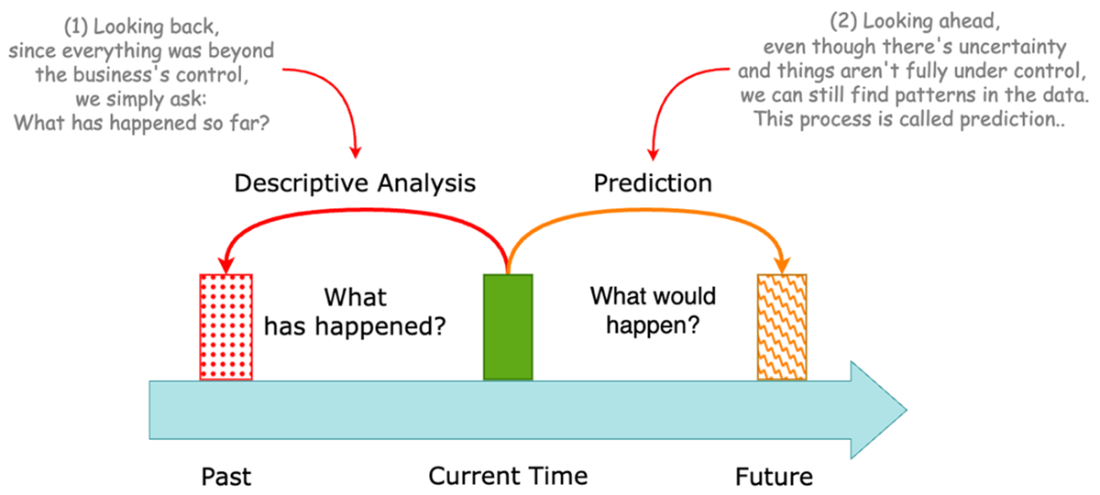
two types of questions and analytical approaches for analyzing external factors.
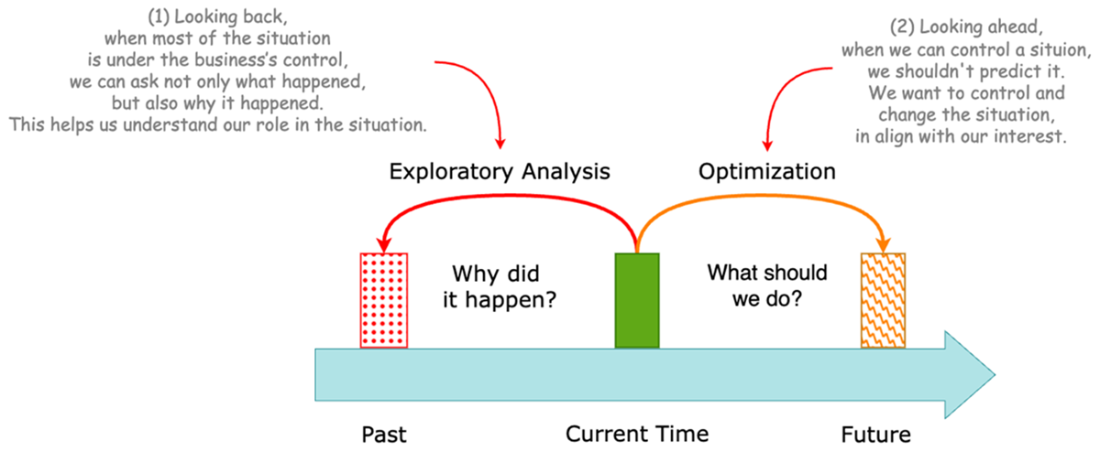
two types of questions and analytical approaches for analyzing internal factors.
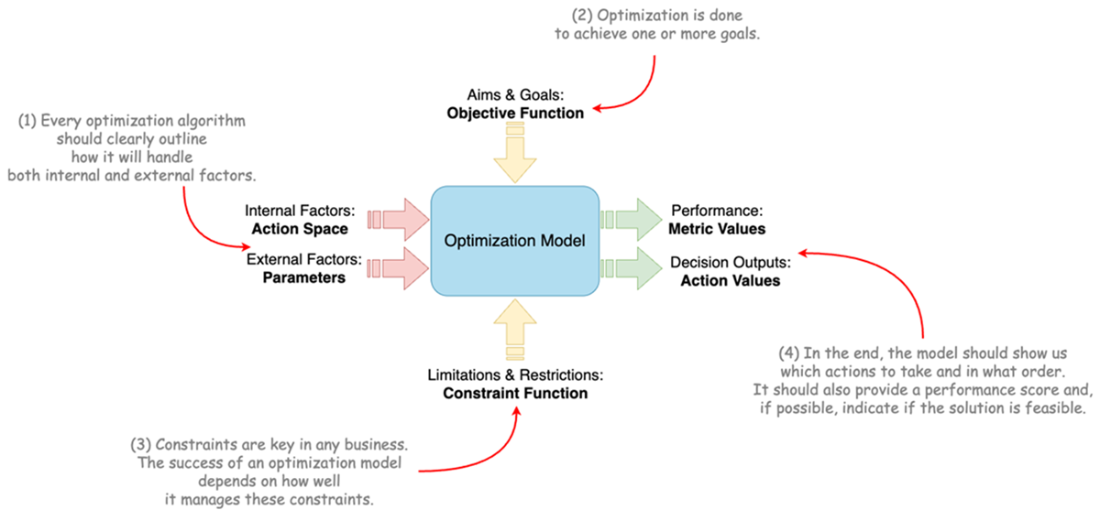
Framework for business optimization models.
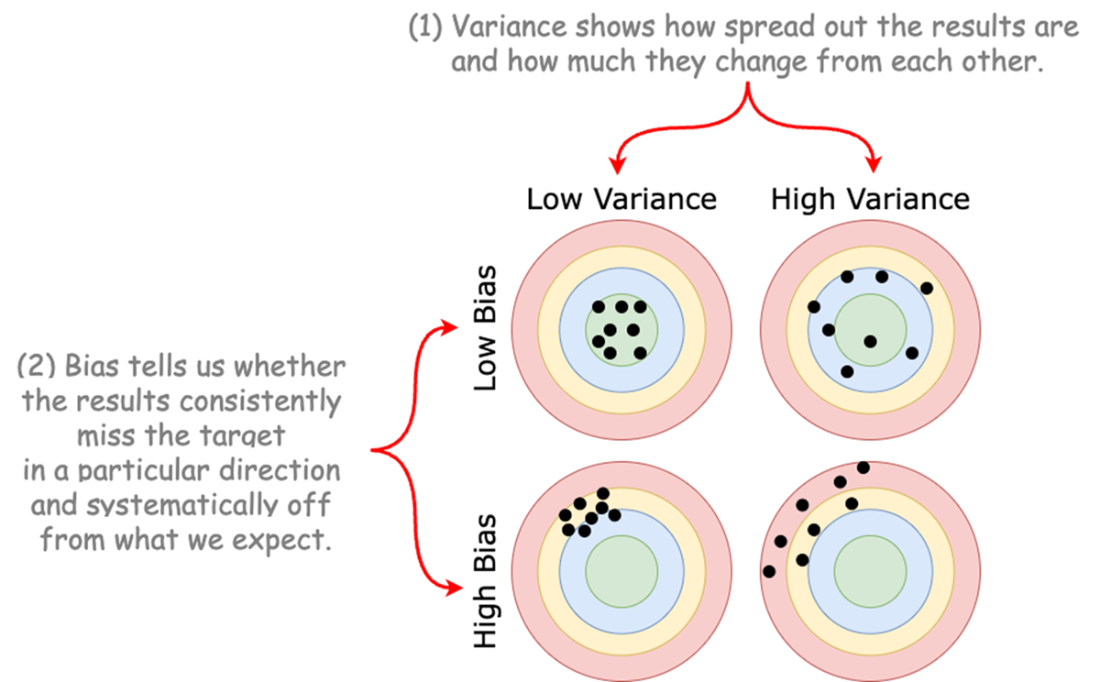
Variance and bias trade off in business optimization models.
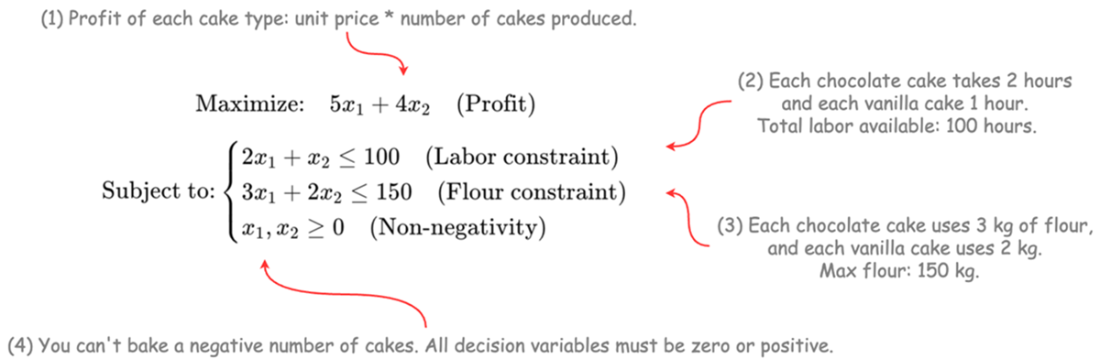
Linear programming formulation of bakery shop problem.
Overview of reinforcement learning framework.

Summary
- Businesses must make smart decisions under uncertainty with limited resources.
- Understanding external (uncontrollable) and internal (controllable) factors is key to effective analysis.
- Business analysis types include descriptive, predictive, explanatory, and optimization.
- Optimization focuses on shaping internal factors to improve future outcomes.
- Decisions in business problems vary by level (strategic/tactical/operational), frequency, scale, and measurability.
- Optimization models include inputs (parameters and decisions), objectives, constraints, objective outputs, and decision values.
- Major challenge in optimization is bias-variance trade-offs in the operational process
- Classical models like operations research, simulation, and system dynamics are powerful but often rigid and static.
- Reinforcement learning extends classical models by enabling adaptive, sequential decision-making.
- Reinforcement learning learns through trial-and-error, using feedback to improve policies over time.
- A comparison shows reinforcement learning excels in adaptability, real-time learning, and dynamic environments.
- Reinforcement learning downsides include training cost, data needs, and explainability—but it's improving rapidly.
- Reinforcement learning is not a replacement but a powerful extension and complement of classical optimization models.
FAQ
What is reinforcement learning for business optimization?
It is a framework for teaching an agent to make sequential decisions under uncertainty by interacting with its environment, receiving rewards or penalties, and improving a policy to maximize long-term value. It suits domains like pricing, logistics, inventory, and customer engagement where conditions change and decisions compound over time.How is reinforcement learning different from supervised and unsupervised learning?
- Unsupervised: finds patterns in unlabeled data (e.g., customer clustering).- Supervised: learns a mapping from inputs to labeled outputs (e.g., churn prediction).
- Reinforcement learning: learns how to act. The agent explores, gets feedback (rewards), solves credit assignment over time, and optimizes cumulative, long-term reward.
What types of business questions map to descriptive, predictive, explanatory, and optimization analyses?
- External factors: Past → Descriptive (What happened?); Future → Predictive (What will happen?).- Internal factors: Past → Explanatory (Why did it happen?); Future → Optimization (What should we do?).
Examples: inflation trend (descriptive), raw material forecast (predictive), sales drop causes (explanatory), truck dispatch schedule (optimization).
When is business optimization typically the right fit?
Usually when decisions are operational, recurring or periodic, span multiple entities (e.g., products, vehicles, staff), and are quantifiable. Decision context can be described by level (strategic/tactical/operational), cycle (periodic/one-time/occasional), dimensions (single/multi-entity), and quantifiability (quantitative/qualitative).What are the core components of a business optimization model?
- Inputs: external parameters (e.g., demand forecasts, lead times) and decision variables (actions).- Objectives: one or more goals to maximize or minimize (e.g., cost, service, throughput).
- Constraints: real-world limits and rules (capacity, regulations, SLAs).
- Outputs: objective metrics and recommended actions (e.g., routes, schedules, quantities).
What common real-world problems are good candidates for optimization?
- Inventory replenishment across stores and SKUs.- Vehicle routing and dispatching for delivery fleets.
- Production scheduling on machines/lines.
- Workforce shift rostering with coverage constraints.
- Bike-sharing station rebalancing.
- Dynamic pricing for perishable or time-sensitive inventory.
What challenges do business optimization models face in practice?
Key evaluation dimensions include robustness, resilience, real-time responsiveness, adaptability, flexibility, generalizability, customizability, effort to build and to operationalize, lifecycle cost, and interpretability. There’s an inherent bias–variance trade-off: improving stability can reduce accuracy and vice versa.What are classical approaches (OR, simulation, system dynamics, game theory) and their limits?
- Operations research: formulates variables, objectives, constraints; solved by LP/MIP/NLP solvers; can be rigid and sensitive to assumption changes.- Stochastic simulation (incl. discrete-event): explores performance under uncertainty; not directly optimizing without additional search.
- System dynamics: models feedback and delays for long-term policy effects; strategic but coarse-grained.
- Game theory: models multi-agent strategy; solutions can be complex and assumption-heavy.
What does reinforcement learning add beyond classical models?
It learns by interacting, handles delayed rewards, adapts to changing environments, and can offer fast inference once trained. RL extends classical methods with experience-driven policies rather than requiring a fully specified model up front. Caveats: training can be data- and compute-intensive, and policies may be less interpretable.When should I use reinforcement learning versus classical optimization?
- Prefer classical optimization when the system is well-specified, stable, constraints are clear, and you need transparent, one-shot plans.- Prefer RL when decisions are sequential with delayed effects, the environment shifts, exploration is valuable, and rapid adaptation is needed.
Prerequisites for RL: a reliable simulator or safe live experimentation, a meaningful reward signal, and governance for constraints and safety.

 Reinforcement Learning for Business ebook for free
