Overview

1 How RAG research prevents disasters

Retrieval-Augmented Generation (RAG) connects large language models to authoritative, current knowledge sources so responses are grounded rather than guessed. The chapter opens with a cautionary lesson: a customer-service chatbot confidently contradicted the airline’s own policy, illustrating a factually inconsistent hallucination that led to legal and financial consequences. Beyond one incident, the authors argue that organizations repeatedly face three enduring constraints—keeping knowledge current, preventing hallucinations during synthesis, and accessing private, fast-changing internal data—making RAG not a fad but a durable architectural pattern. Research literacy becomes a strategic edge: teams that understand how RAG really works can anticipate limitations, engineer safeguards, and turn reliability into a competitive advantage.

To move from trial-and-error to engineering discipline, the chapter introduces a seven-point taxonomy of RAG failures—missing content, missed top rank, factually inconsistent hallucination, not in context, not extracted, incorrect specificity, and incomplete answers—and shows how these issues quietly erode trust even when systems are “usually” right. It maps failure modes to concrete remedies across the indexing and query pipelines: better curation and chunking, query expansion and hypothetical document generation, hybrid retrieval and re-ranking, result fusion, context compression and organization, and generation-time grounding and verification. Research-backed methods such as Self-RAG (confidence and self-critique), FLARE (active, need-aware retrieval), HyDE (bridging query–document vocabulary gaps), and result-fusion strategies help detect uncertainty, trigger additional retrieval, and align synthesis with sources. The chapter also weighs costs and infrastructure trade-offs, noting that while longer contexts, fine-tuning, and caching strengthen RAG, they do not replace retrieval-first grounding.

Finally, the authors chart an architectural progression that guides investment: Naive RAG for rapid, low-cost foundations; Advanced RAG to optimize preprocessing, retrieval, and context for production; Modular RAG to compose specialized components across diverse data and tasks; and Agentic RAG for autonomous, iterative information seeking with self-monitoring and multi-step reasoning. Each stage has clear upgrade triggers tied to accuracy demands, domain complexity, risk, and scale, along with operational considerations like orchestration, evaluation, and cost controls. The book’s teaching approach emphasizes research literacy, prevention of known failure modes, progressive complexity, hands-on implementation, and systematic evaluation—so practitioners can predict, measure, and improve reliability before failures undermine user trust.

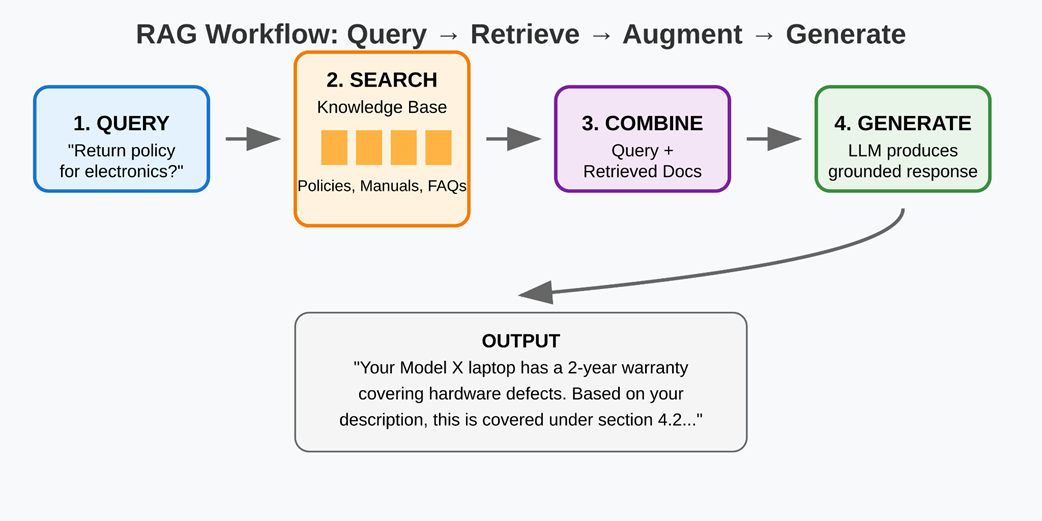
The RAG workflow — from user queries to grounded responses through retrieval and generation.
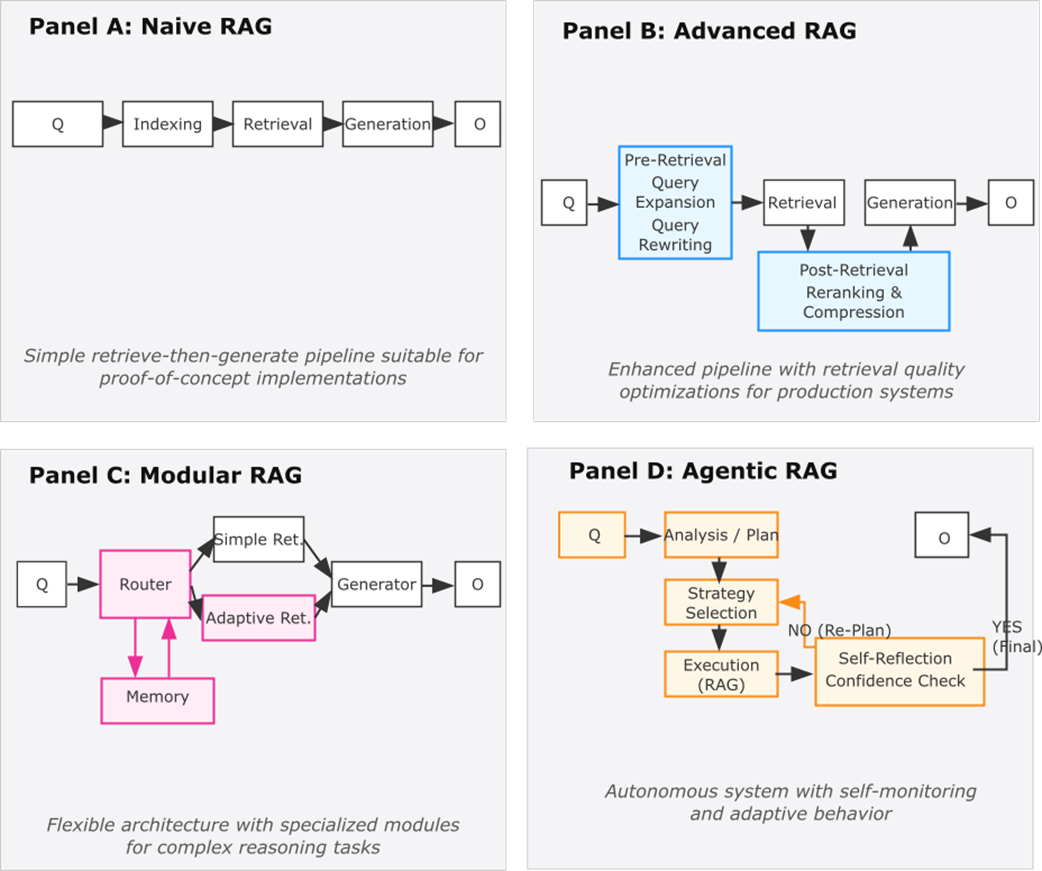
RAG architectural evolution from Naive to Agentic implementations. Each paradigm builds upon its predecessors while adding specialized components and capabilities to address increasingly complex requirements.
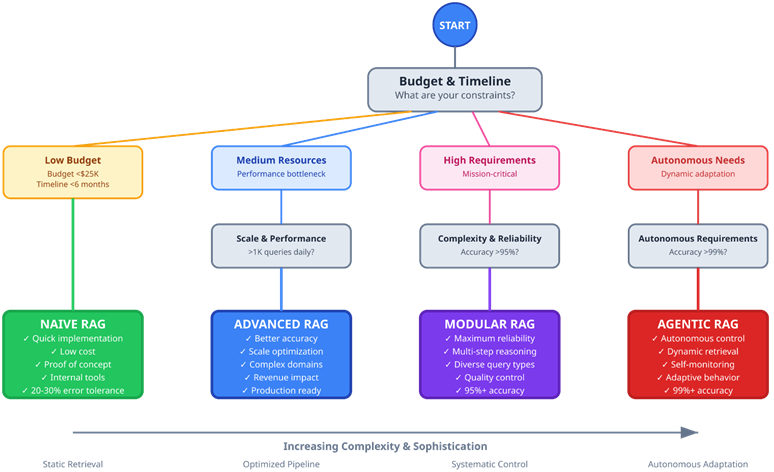
RAG Implementation Decision Tree — Business Decisions guiding RAG choices.
Summary

  • Retrieval-Augmented Generation solves three critical limitations that make standalone language models unreliable for production applications: knowledge boundaries that prevent access to current information, hallucinations that generate unverifiable claims, and the inability to incorporate private organizational knowledge that drives business decisions.
  • The seven-point failure taxonomy provides a systematic diagnosis for RAG system problems rather than guessing at solutions. Failure points, such as "Missed the Top Rank" and "Factually Inconsistent Hallucination," enable the precise identification of issues and the selection of research-backed solutions that address specific failure modes.
  • RAG systems evolve through four architectural stages based on complexity requirements and business needs. Naive RAG establishes basic retrieve-then-generate functionality for proof-of-concept applications. Advanced RAG optimizes retrieval quality and context processing for production performance. Modular RAG implements adaptive strategies and quality control for mission-critical applications. Agentic RAG introduces autonomous planning and self-correction to the retrieval and generation loop.
  • The core RAG architecture coordinates two specialized components: retrieval systems that find relevant information from external knowledge sources, and generation systems that synthesize retrieved context with user queries to produce grounded, factual responses. This coordination enables AI systems that combine broad language capabilities with specific, current, and verifiable knowledge.
  • Research literacy transforms technology evaluation from reactive debugging to proactive problem-solving. Understanding the academic foundations behind RAG techniques enables independent assessment of new approaches, strategic planning for system evolution, and adaptation to changing requirements without waiting for tutorials or expert opinions.

FAQ

What is Retrieval-Augmented Generation (RAG), and how is it different from search or pure LLMs?RAG connects a language model to external knowledge sources at query time so responses are grounded in retrieved evidence. Unlike search, which returns documents for humans to read, and unlike pure LLMs, which rely only on training data, RAG retrieves relevant passages and uses them to inform generation in real time.
What went wrong in Air Canada’s chatbot incident, and which failure point did it illustrate?The bot retrieved the correct policy page but generated an answer that contradicted it, promising a retroactive bereavement discount that didn’t exist. This is Failure Point 3: Factually inconsistent hallucination (ungrounded generation). The tribunal held the company responsible, underscoring the need for grounding, uncertainty signals, and oversight.
What is the “knowledge boundary” problem, and why can’t bigger context windows fix it?Organizational knowledge changes daily; new facts don’t exist in a model’s training data. Even very large context windows can’t add information that hasn’t been ingested. RAG addresses this by retrieving current, authoritative sources at inference time and clarifying what the system does and doesn’t know.
Why don’t larger LLMs eliminate hallucinations?Bigger models can make hallucinations more plausible and harder to detect. The core issue is unverifiable synthesis: combining information without clear provenance. Research like Self-RAG adds confidence indicators and retrieval-aware self-critique, but hallucination control remains an ongoing challenge requiring grounding and verification.
Why can’t fine-tuning on private data replace RAG for enterprise use?Private knowledge changes frequently, comes with access controls, and spans varied formats. Training alone can’t keep up or enforce permissions. RAG integrates private, proprietary, and real-time data with the right access, preserving both general model competence and up-to-date, user-specific accuracy.
Why is RAG an enduring architectural pattern despite longer contexts, LoRA fine-tuning, and caching?These techniques enhance RAG but don’t replace it. Retrieval-first pipelines deliver precision and cost efficiency by pre-filtering relevant content, outperforming long-context alone on knowledge-intensive tasks. LoRA improves components (e.g., generator behavior) without sacrificing modular updating. Caching optimizes performance inside the same retrieval+generation framework.
How do the two RAG pipelines (indexing and query) work together?The indexing pipeline chunks and encodes documents, storing them in a searchable store. At query time, the system: (1) processes the question, (2) retrieves relevant passages, (3) combines them with the query, and (4) generates an answer grounded in the retrieved evidence. Retrieval techniques target missing/hidden context issues; generation techniques target faithful use of that context.
What are the seven failure points in RAG, and how does the taxonomy help?The taxonomy includes: FP1 Missing content, FP2 Missed the top rank, FP3 Factually inconsistent hallucination, FP4 Not in context, FP5 Not extracted, FP6 Incorrect specificity, FP7 Incomplete. It turns debugging into diagnosis: identify the specific failure and apply targeted fixes (e.g., hybrid search or RRF for FP2, better context filtering for FP4, extraction prompts for FP5).
Which research-backed techniques mitigate common RAG failures?Examples include: HyDE (bridges query–document vocabulary gaps, helping FP2/FP6), Self-RAG (reflection tokens for confidence and evidence checks, addressing FP3/FP5), FLARE (active, iterative retrieval when confidence is low, addressing FP1/FP3/FP4), and RAG-Fusion/reciprocal rank fusion plus hybrid search (improve retrieval ranking for FP2).
When should I choose Naive, Advanced, Modular, or Agentic RAG?Use Naive RAG for quick proofs in well-structured domains and tolerant users. Move to Advanced RAG when retrieval quality limits accuracy or scale demands optimization. Adopt Modular RAG for diverse use cases, multi-source integration, and independent scaling/QA. Choose Agentic RAG for dynamic, multi-step tasks that need autonomous retrieval decisions, confidence-based triggers, and iterative refinement.

pro $24.99 per month

  • access to all Manning books, MEAPs, liveVideos, liveProjects, and audiobooks!
  • choose one free eBook per month to keep
  • exclusive 50% discount on all purchases
  • renews monthly, pause or cancel renewal anytime

lite $19.99 per month

  • access to all Manning books, including MEAPs!

team

5, 10 or 20 seats+ for your team - learn more


choose your plan

team

monthly
annual
$49.99
$499.99
only $41.67 per month
  • five seats for your team
  • access to all Manning books, MEAPs, liveVideos, liveProjects, and audiobooks!
  • choose another free product every time you renew
  • choose twelve free products per year
  • exclusive 50% discount on all purchases
  • renews monthly, pause or cancel renewal anytime
  • renews annually, pause or cancel renewal anytime
  • Retrieval Augmented Generation, The Seminal Papers ebook for free

choose your plan

team

monthly
annual
$49.99
$499.99
only $41.67 per month
  • five seats for your team
  • access to all Manning books, MEAPs, liveVideos, liveProjects, and audiobooks!
  • choose another free product every time you renew
  • choose twelve free products per year
  • exclusive 50% discount on all purchases
  • renews monthly, pause or cancel renewal anytime
  • renews annually, pause or cancel renewal anytime
  • Retrieval Augmented Generation, The Seminal Papers ebook for free