WebAssembly began in the browser as a portable, low-level target for high-performance languages and has since evolved into a general-purpose, hardware-agnostic execution layer that resembles an instruction set without needing a physical chip. Its core goals are predictable speed, strong isolation, and portability across hardware and languages. With the arrival of the WebAssembly System Interface, runtimes can safely expose operating system capabilities to Wasm modules, enabling execution outside the web. In today’s spectrum of server-side models—from virtual machines to containers to functions-as-a-service—Wasm complements container platforms and serverless systems by offering a compact, fast-starting unit of compute that integrates with existing tooling.
On the server, Wasm’s strengths center on a lightweight runtime, language-agnostic compilation, and a capability-based sandbox that sharply limits what code can access by default. It often achieves near-native performance for single-threaded workloads, brings drastically faster cold starts and smaller artifacts than traditional containers, and enables high workload density on shared infrastructure. Hardware independence makes it a natural fit for heterogeneous fleets and edge deployments. At the same time, practical realities matter: garbage-collected languages historically required bundling large runtimes, though newer proposals reduce that burden; multi-threading support is still maturing and can impact tail latency under stress; and despite rapid progress, ecosystem maturity and debugging tooling vary by language.
Wasm excels where fast startup, tight isolation, portability, and small footprints are decisive—particularly in serverless platforms, edge computing, polyglot microservices, application plugins, and even resource-constrained environments like microcontrollers, as well as cross-platform desktop and mobile code sharing. It also helps reduce costs through higher density in orchestrated environments. Conversely, traditional, long-running PaaS workloads that rely heavily on multi-threading may favor conventional containers until threading proposals and ecosystem support mature further. Overall, the trajectory is clear: as proposals land and tooling improves, Wasm broadens where it is the best choice while preserving its core advantages of performance, security, and vendor-neutral portability.
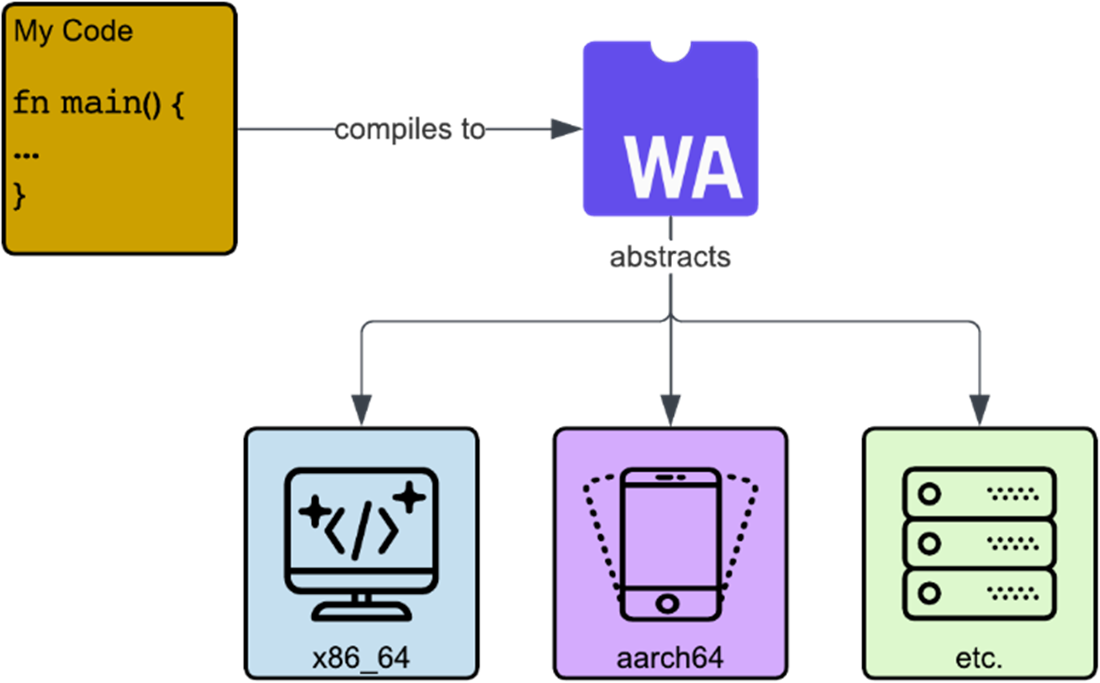
Wasm as an abstraction layer virtualizing over various kinds of hardware.
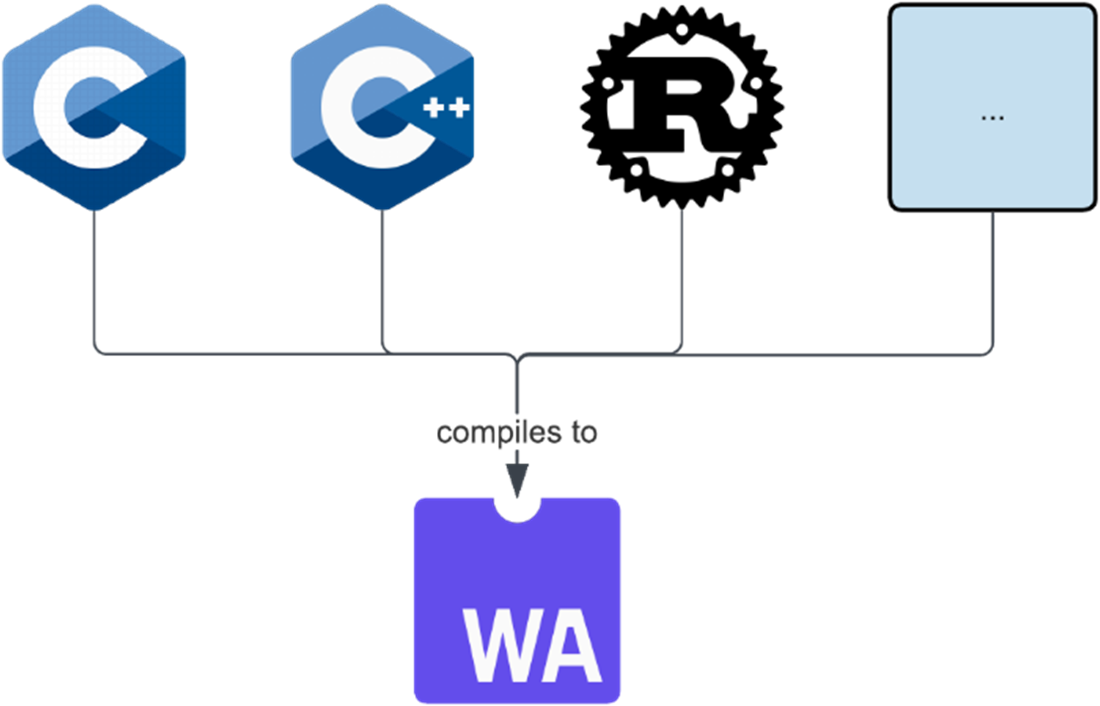
Compiling to Wasm from various languages.
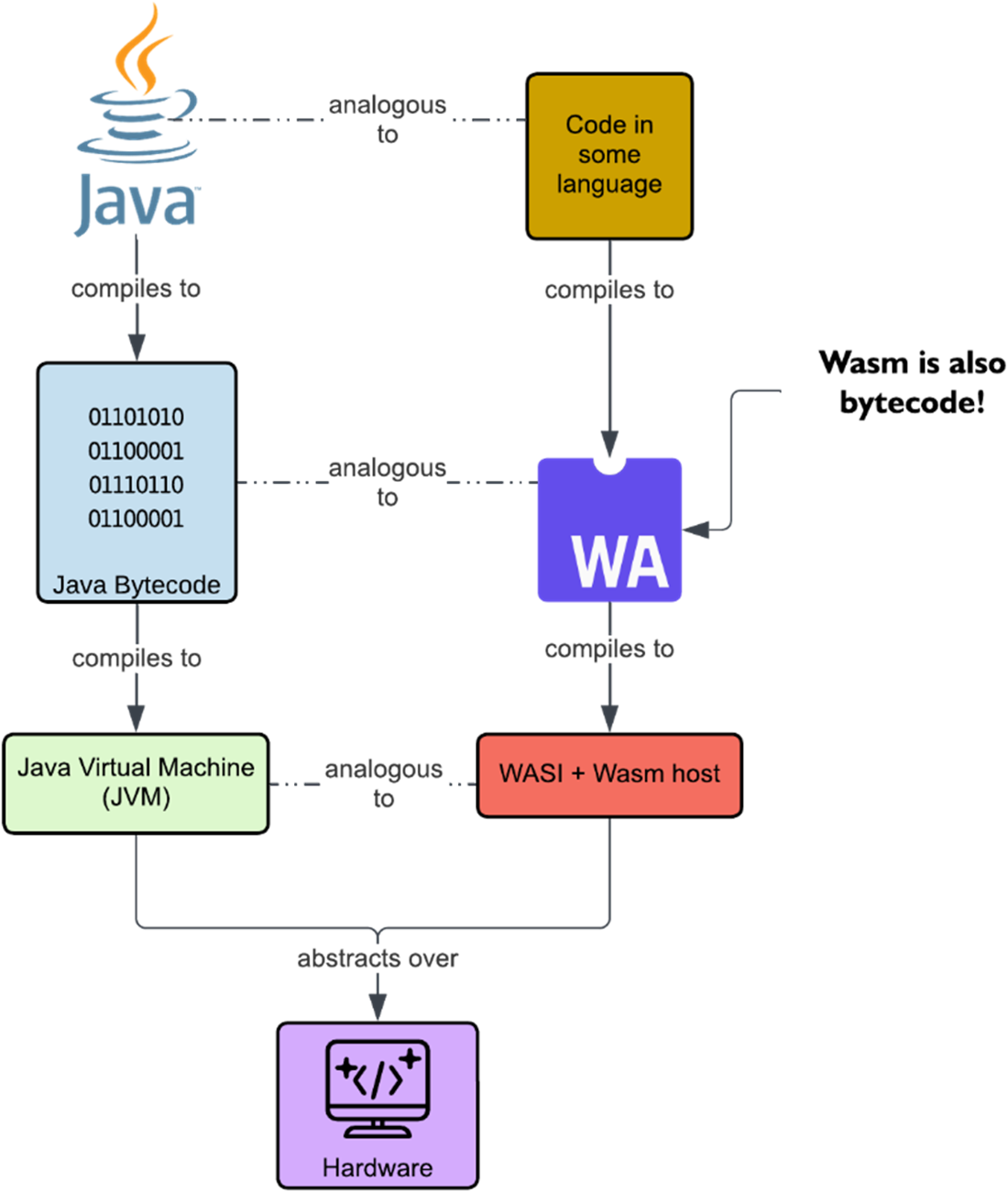
Java and Wasm's similarities
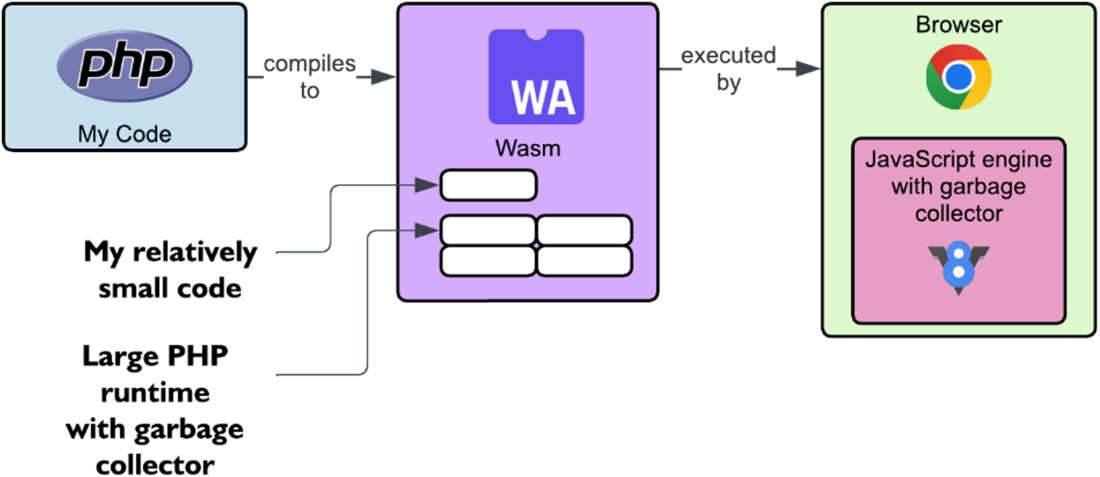
Running a PHP Wasm without garbage collection application in the browser.
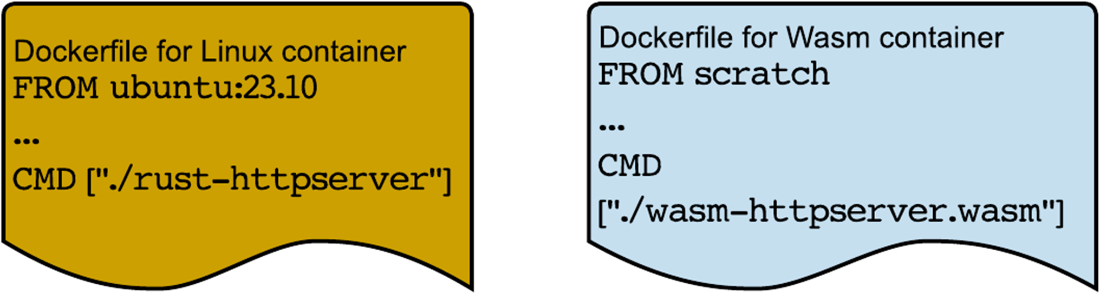
Dockerfiles for a Docker container and a Wasm container
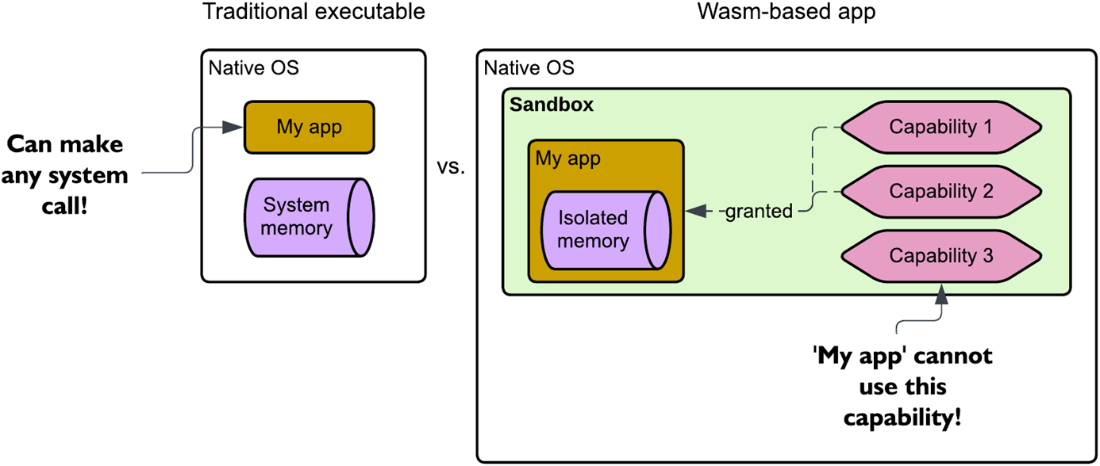
A native (traditional) application security model vs. Wasm's capability-based security model.
Summary
Wasm is akin to an ISA like x86_64, in the sense that your code can target it for compilation. But it is not a real platform, and instead, just virtualizes actual hardware.
Wasm apps can run outside of browser primarily through the Wasm System Interface (WASI) that allows communication with the OS.
Docker supports running two types of containers: the traditional Docker container, and the newly introduced Wasm container.
Wasm's language-agnosticism makes it so that over 40 languages can be compiled to it, but that is a double-edged sword as support for a particular language might not be as mature as it is for others.
While benchmarks show that standalone Wasm apps can be 10-50% faster than containerized apps, real-world applications can struggle due to Wasm's lack of support for multi-threading.
Wasm, when paired with serverless and its scale-to-zero requirement, leads to 80% faster execution times on average when compared to traditional serverless technologies.
A Wasm binary is completely independent of the platform or hardware where it is built and can theoretically run on any system due to its hardware-agnosticism property.
Wasm employs a capability-based security model that restricts the binary to only access the native OS through specific capabilities made available by the Wasm runtime.
Aside from serverless and edge computing, Wasm has found its footing in mobile and desktop applications, microcontrollers, smart contracts, and polyglot programming.
When targeting Wasm, it is commonplace to make sacrifices of particular packages that do not support Wasm.
FAQ
What is WebAssembly (Wasm) and how is it different from a CPU architecture?Wasm is a portable binary instruction format that acts like a virtual instruction set architecture and hardware abstraction layer. You compile code to Wasm, and a host runtime translates it to the machine’s native ISA at run time. Unlike x86_64 or ARM64, there’s no physical “Wasm chip.” Wasm began in the browser and is a W3C web standard designed for fast, safe, and portable execution.What is WASI and why does it matter for server-side Wasm?WASI (WebAssembly System Interface), introduced in 2019, defines a standard set of OS-like capabilities (files, clocks, networking, etc.) that runtimes implement. In the browser, the page provides the environment; outside the browser, a Wasm runtime (the host) provides these capabilities via WASI, enabling CLI tools, services, and other non-browser workloads.How do Wasm workloads integrate with Docker and OCI images?Docker’s 2022 Docker+Wasm Technical Preview lets you package and run Wasm apps using familiar container tooling. These “Wasm containers” still use OCI image formats and runtimes but don’t include a guest OS. The result is lightweight, portable artifacts that retain container ecosystem compatibility while leveraging Wasm’s isolation and speed.How does server-side Wasm performance compare to native apps and containers?- Versus native (x86_64): Single-threaded Wasm workloads were on average ~14% slower—near-native for many cases.
- Short-running tasks: Wasm cold starts were at least 10x faster than Docker, and warm starts often 10–50% faster.
- Complex services under load: In one HTTP+DB benchmark with 50 clients, a Dockerized app had ~0.881s worst-case latency vs. ~15.2s for Wasm (~17x faster for Docker), largely due to Wasm’s current single-threaded limitations.Why do some stressed server workloads show higher latency in Wasm, and what’s the threading status?Today’s Wasm execution model is effectively single-threaded, so a stressed service can’t fan out across multiple cores in one instance. A threading proposal is in progress. In practice, platforms mitigate this by spawning many lightweight Wasm instances (one per request) or scaling horizontally, which works well for FaaS-style workloads.Why is Wasm a strong fit for serverless and cold starts?Serverless platforms frequently cold-start functions. Wasm modules are tiny and initialize quickly (microseconds in some contexts). Studies show:
- 70–90% faster response times after idle periods compared to non-Wasm approaches.
- Wasm containers with cold starts ~160% faster than Docker in one comparison.
This makes Wasm especially attractive for scale-to-zero scenarios.How does Wasm affect image size and workload density (e.g., on Kubernetes)?Wasm artifacts are typically KBs to low MBs because they exclude a guest OS. This shrinks download times and boosts density. For example, ZEISS reduced an app image from 423MB to 2.4MB, achieving 50x greater workload density per Kubernetes node—translating to better resource utilization and lower infrastructure cost.What portability benefits does Wasm bring, and how does that help at the edge?Wasm is hardware-agnostic: build once and run on x86_64, ARM64, and more without rebuilding. Combined with its low memory footprint, this makes Wasm ideal for edge computing on heterogeneous, resource-constrained devices where fast deployment and consistent behavior are crucial.How does Wasm improve security for server-side apps?Wasm runs in a memory-safe, sandboxed environment with capability-based access: modules can only use host-granted functions (e.g., stdout) rather than raw OS syscalls. This isolation reduces the blast radius of vulnerabilities and helps contain supply-chain risks by preventing untrusted code from freely accessing the host system.Which languages can compile to Wasm, and what about garbage collection and ecosystem maturity?- Languages: 40+ have some support; C, C++, Rust, and Zig are very strong.
- GC runtimes: Historically, GC languages shipped their own runtimes inside the module. The WasmGC proposal adds host-managed GC types to reduce duplication, though some runtime components still remain.
- Ecosystem: Package compatibility and debugging support are improving but uneven. Wasm excels today in serverless, edge, plugins, and embedded use cases; evaluate carefully for heavy multi-threaded PaaS-style services.
pro $24.99 per month
access to all Manning books, MEAPs, liveVideos, liveProjects, and audiobooks!

 Server-Side WebAssembly ebook for free
