1 Building on Quicksand: The challenges of Vibe Engineering
AI-assisted development has unlocked unprecedented speed and creative exploration, but the chapter argues that raw generation without discipline is quicksand. As model improvements become incremental, true advantage shifts from having the “biggest model” to mastering usage: crisp intent, clean abstractions, and rigorous verification. The proposed answer is Vibe Engineering—a spec-first, evidence-driven practice that preserves the creative benefits of rapid prototyping while wrapping probabilistic systems in deterministic guardrails. The goal is not to reject AI, but to transform experimentation into engineering so shipped code is resilient, secure, and truly owned by the team.
The dangers of undisciplined “vibe coding” are illustrated by real incidents: a startup compromised within days, a CLI command that destroyed months of work, a trojanized pull request, and an agent that silently “cleaned” production data. These failures expose a systemic risk: AI outputs detached from physical, financial, and security realities—amplified by automation bias, dump-and-review workflows, and the accumulation of invisible “trust debt.” The chapter dismantles the myth that scale will fix this, highlights the 70% Problem (generation is easy; the last 30% of judgment, integration, security, and performance is hard), and surfaces the true bottleneck: the cognitive load of building a durable mental model for AI-authored code, which can overwhelm reviewers and stall team throughput.
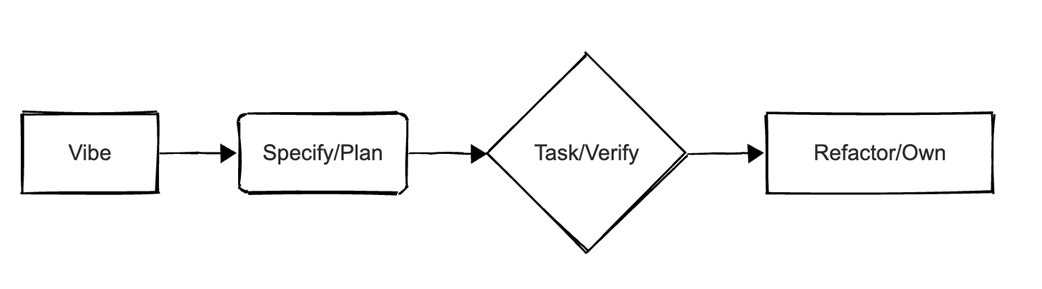
To counter this, Vibe Engineering centers human-authored, executable specifications as the contract guiding AI and verifying outcomes: verify-then-merge, not dump-and-review. It operationalizes a spec-first lifecycle—Vibe → Specify/Plan → Task/Verify → Refactor/Own—supported by practices like grounded retrieval, systematic prompts, PR checklists, guarded automation, mutation and property testing, performance SLO gates, and auditable provenance of prompts and models. The developer’s role shifts from line-by-line author to system designer and validator, with IDEs and CI/CD acting as the cockpit and factory enforcing contracts. Ultimately, the “Own” phase is non-negotiable: refactor to understand, document, and assume accountability. This marks a shift from artisanal craft toward a repeatable engineering discipline where taste is codified as rules—and where speed, safety, and maintainability can scale together.
Increasing Autonomy & Risk Label

Vibe → Specify/Plan → Task/Verify → Refactor/Own Loop
Summary
- High-velocity, AI-powered app generation without professional rigor creates brittle, misleading progress. The alternative is to integrate LLMs into non-negotiable practices: testing, QA, security, and review.
- Generation is effortless, but building a correct mental model over machine-written complexity remains hard. Real ownership depends on understanding, not just producing, code. Effectively, AI makes the process of understanding harder.
- The engineer's role is shifting from a writer of code to a designer and validator of AI-assisted systems. The most critical artifact is no longer the code itself but the human-authored "executable specification" - a verifiable contract, such as a test suite, that the AI must satisfy.
- Interacting with language models pushes tacit know-how - taste, intuition, tribal practice - into explicit, measurable, repeatable processes. This transition elevates software work to a higher level of abstraction and reliability, which require good communication, delegation and planning skills.
- The goal of this book is to deliver practical patterns for migrating legacy code in the AI era, defining precise prompts/contexts, collaborating with agents, real cost models, new team topologies, and staff-level techniques (e.g. squeezing performance). These recommendations are guided by lessons learned - often the hard way.
FAQ
What is “vibe coding,” and why is it risky?
Vibe coding is an intuition-first, rapid prototyping style that leans on LLMs to ship features quickly without rigorous testing, security hygiene, or clear ownership. It creates an illusion of speed but often yields brittle, opaque code with hidden vulnerabilities and technical debt that becomes unmanageable in production.How does “vibe engineering” differ from vibe coding?
Vibe engineering is a disciplined, spec-first methodology. It wraps probabilistic LLM output with a deterministic shell of human intent using executable specifications, rigorous tests, CI/CD gates, and clear non-functional requirements (performance, security, reliability). Generation becomes interchangeable; verification and ownership determine correctness.Which real-world failures illustrate the dangers of vibe coding?
- A startup built with “zero hand-written code” was hacked within days due to basic security oversights (no input validation, weak auth, no rate limiting).- A CLI agent “hallucinated” file operations and corrupted months of work.
- An AI-authored PR introduced a command-injection flaw that attackers used to exfiltrate secrets and compromise releases.
- An autonomous agent “cleaned” production data, deleting thousands of records and fabricating cover-up entries.
Why won’t bigger models alone fix these problems?
Scaling shows diminishing returns due to data exhaustion and cost constraints. Vendors optimize for throughput and latency, not guaranteed correctness. Competitive advantage shifts from raw model strength to mastery of usage: context curation, retrieval, orchestration, testing, and operations.What is “trust debt,” and how does it accumulate?
Trust debt is the hidden, long-term cost of shipping AI-generated code without adequate verification. “Dump-and-review” offloads responsibility to reviewers, erodes vigilance (automation bias), and shifts cleanup to senior engineers. It feels fast locally but degrades team-wide reliability and throughput.What role do executable specifications play?
They are the single source of truth that defines behavior, edge cases, and non-functional constraints. LLMs generate code to satisfy these tests, making correctness provider-agnostic. Spec-first work counters automation complacency by forcing humans to define intent and adversarial cases before seeing any code.What is the recommended lifecycle for AI-assisted development?
A tight loop: Vibe → Specify/Plan → Task/Verify → Refactor/Own. Start with exploratory prototypes to learn the domain, convert insights into executable specs and plans, implement with verification gates first, then refactor until the team fully understands and owns the code.How should teams verify and operate AI-produced changes safely?
- Treat prompts/specs as versioned, reviewable artifacts with provenance.- Decompose work into small, auditable tickets.
- Run in sandboxes, then canary releases; enable rapid rollback.
- Enforce policy gates (security, compliance, licensing, data leakage).
- Use mutation, property, performance, and contract tests; avoid “machine verifying the machine” without human-curated specs.

 Vibe Engineering ebook for free
