Each eBook brings together four or five chapters into one focused path through a topic. Pick one, tell us where to send it, and we'll email you the link.
Building a specialized model requires a variety of decisions.
This free ebook helps you make sense of them, from choosing training examples and fine-tuning your model to planning experiments that make good use of your testing budget. Across five complementary chapters from Manning books, you’ll explore Bayesian optimization through a compiler example, examine the strengths and limitations of LLM judges, and investigate runtime performance with ONNX profiling. You’ll come away with practical methods you can apply as you develop, evaluate, and refine your own models.
Find out what’s slowing your LLM down—and what you can do about it.
This eBook brings together five chapters from Manning books to help you make informed choices about inference, model efficiency, and production deployment. Explore ways to ease memory pressure, balance quantization savings with output quality, and reduce data movement with fused Triton kernels. Then learn how batching, streaming, and rate limiting help you handle requests in a running service. Whether you’re refining a prototype or preparing for deployment, you’ll gain practical techniques to try on your own workloads and a stronger foundation for further study of LLM optimization and GPU programming.
Choose a model that suits your task, adapt it to your needs, and build software that runs locally.
This free eBook features four chapters from four Manning books, covering small language models, specialization with LoRA and DoRA, CPU inference with GGUF and llama.cpp, and application development through Ollama’s Python library. Get practical guidance on producing structured outputs, making informed quantization choices, and handling streaming responses and chatbot conversation history. Get a firmer grasp of the choices behind local AI as well as concrete techniques to try in your next project, without depending on a hosted inference service.
Every step between asking a question and sharing the answer is a chance to make your analysis more useful.
This free four-chapter ebook helps you make thoughtful decisions at four key stages of that process. Follow a help center investigation to see how a broad request becomes a measurable question, practice cleaning messy records with pandas, and learn to choose visuals that help readers interpret your findings accurately. Then use the DIKW pyramid to give your findings context and suggest next steps. You’ll come away with practical approaches to try in your own work, from the first conversation about a project to the story you share at the end.
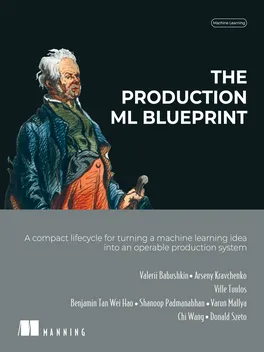
What happens between a working prototype and a production release?
This four-chapter ebook was created with the answer in mind, offering a focused look at system design, data preparation, pipeline orchestration, and deployment. Learn to uncover design weaknesses before implementation, explore faster data access and processing, and follow a batch inference example built with Kubeflow Pipelines. Then examine how to test inference under realistic conditions and compare strategies for releasing model updates. You’ll get concrete examples of the engineering decisions beyond model development as well as practical guidance for your next machine learning project.
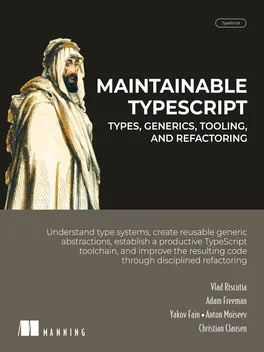
Make your next TypeScript project easier to reason about, debug, and maintain.
This free ebook brings together four chapters from four Manning books, guiding you from understanding type systems to creating reusable generics, exploring TypeScript tooling, and refactoring without changing behavior. Learn how to catch type errors before execution, reduce duplicate code, and make code easier to read and change.
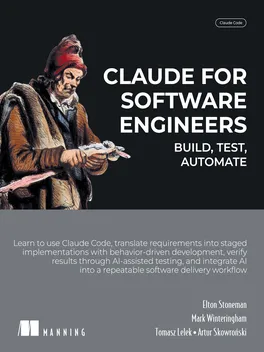
Put AI to work on software you can confidently review, test, and deliver.
This ebook starts with Claude Code, then shows you how to turn requirements into clear behaviors and build features in manageable stages. You’ll explore AI-assisted unit testing and the red/green/refactor cycle before taking these practices into team workflows, with shared instructions, agent handoffs, and CI automation. Along the way, learn where your judgment matters most and how to keep oversight effective as you delegate more work.
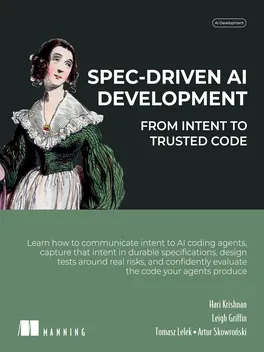
Better agent-produced software starts long before the first line of code, and confidence requires more than a passing test suite.
This ebook brings together four expert chapters on expressing intent, writing durable specifications, testing according to risk, and evaluating code you didn’t write. It’s an excellent starting point for anyone ready to replace guesswork with a practical foundation for directing agents, reviewing their work, and building dependable software faster.
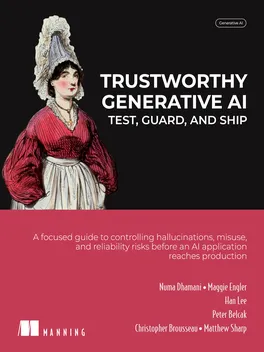
Build safe, reliable, production-ready AI applications that you can trust.
This four-chapter ebook gives you a practical look at the risks that can undermine an AI application as well as the methods used to address them. Examine how systems are exploited through adversarial attacks, evaluate hallucinations with structured detection techniques, learn how to use guardrails to control the flow of information and actions, and see what it takes to deploy and operate an LLM service. By following this curated learning path, you’ll build a stronger foundation for testing AI behavior, making informed design choices, and taking on more advanced work in AI safety, evaluation, agent design, and production engineering.
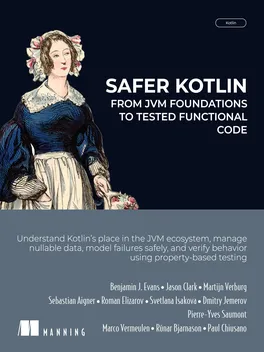
Get a targeted tour of Kotlin techniques you can put to work on the JVM in this free ebook.
Across four chapters from Manning books, you’ll see how Kotlin streamlines familiar programming tasks, learns how to catch many potential null errors during compilation, and works alongside existing Java code. You’ll also explore how to retain error details with Either and Result and use generated inputs to test whether program properties hold. If you’re a developer who wants to write Kotlin code with clearer handling of values, failures, and tests, this curated collection is your practical next step.
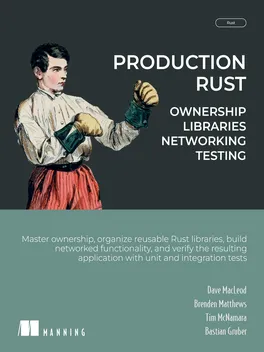
Master ownership, organize reusable Rust libraries, build networked functionality, and verify the resulting application with unit and integration tests.
In this free ebook, containing chapters from four Manning books, you'll go from knowing Rust syntax to understanding how real applications fit together. By the end, you'll be ready to make more informed coding choices and tackle deeper work in Rust libraries, systems programming, and web development.
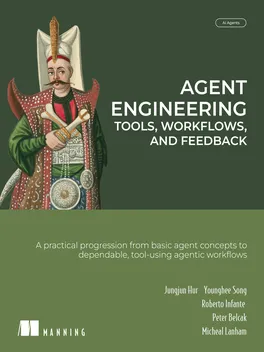
Build agents you can understand, test, and improve!
This practical four-chapter ebook shows you how to choose the right level of autonomy, connect agents to useful tools, break complex processes into manageable parts, and catch weak spots with evaluation and feedback. By the end, you’ll have a solid foundation for creating more reliable agent systems and the technical judgment to take on more advanced agent development.
See what happens after the prompt—and build the technical knowledge to work with LLMs more effectively.
This laser-focused four-chapter ebook combines clear explanations with hands-on implementation, helping you connect foundational concepts to transformer architecture, GPT construction, and modern text-generation techniques. With this practical primer, you’ll strengthen your understanding, sharpen your technical judgment, and approach text-generating models with greater confidence.
Build a stronger foundation for modern frontend work.
You’ll learn how the browser, JavaScript runtime, stylesheets, and components all work together in this free ebook. Featuring four chapters from Manning books, it pairs essential concepts with practical examples, providing you with useful techniques for diagnosing asynchronous behavior, keeping CSS manageable, and creating web components with the Lit library. You’ll come away better prepared to make informed implementation choices, troubleshoot unexpected behavior, and take on more advanced web development topics.
205 pages · eBook
Liked the chapters? Get the complete books behind them in a Manning bundle, any bundle for $99.99.